A Recommendation: "The Peace Chronicles"

Hello friends,

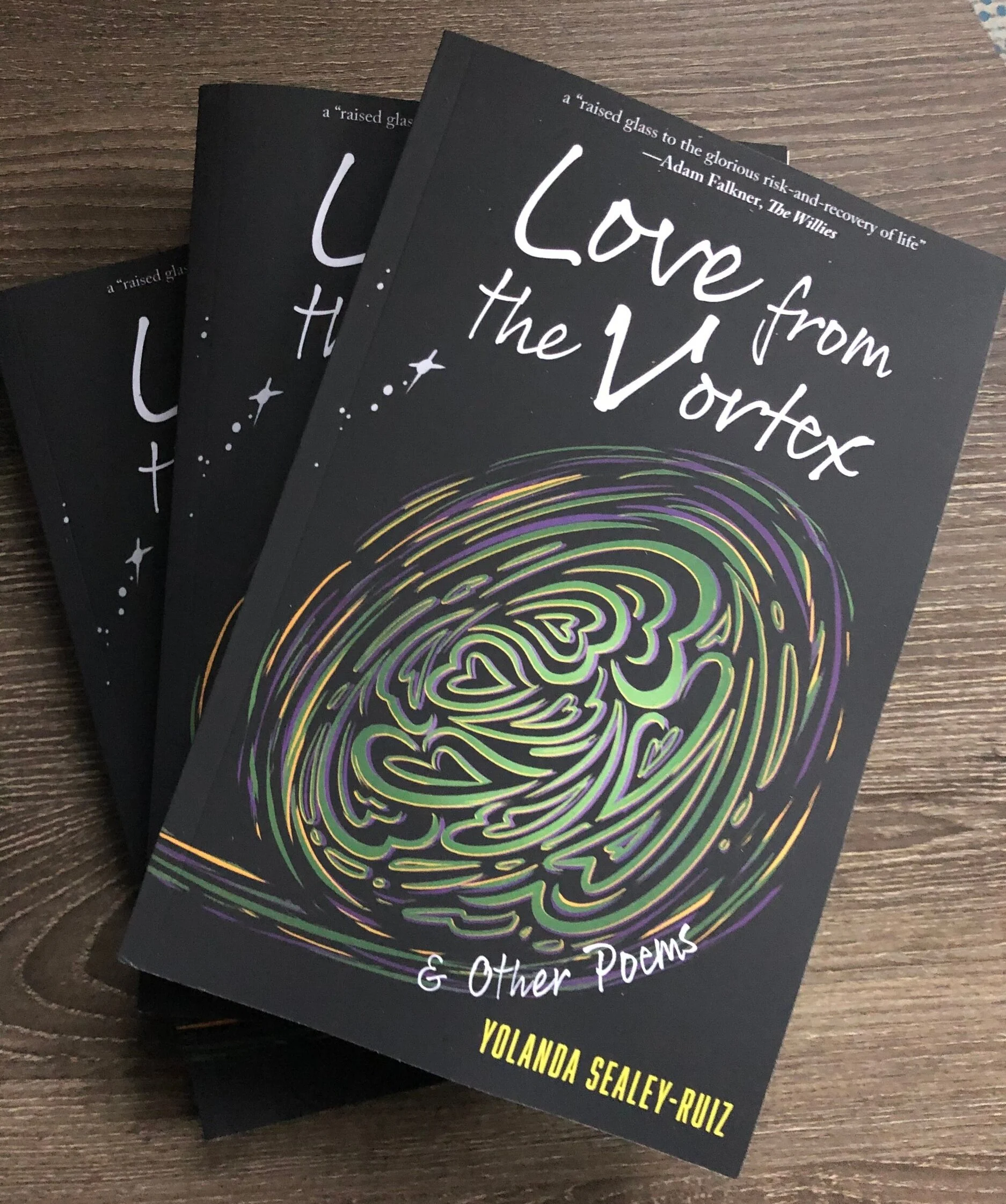
One of my dear mentors, the brilliant and inspiring Dr. Yolanda Sealey-Ruiz, Professor of English Education at Teachers College, Columbia University, has recently released her second full-length book of poems. Like her first poetry collection, Love from the Vortex & Other Poems, which I reviewed here, this new collection aptly entitled The Peace Chronicles is another magnificent work. I was so honored to read it and I was again so deeply touched by her poems. They are stunning in their rawness, honest, humility, and beauty (both pain and joy). If you are interested in purchasing of copy of Dr. Sealey-Ruiz’s book The Peace Chronicles, you can do so here on Amazon.com or directly through her publisher here. Below I put together a few thoughts about the book. I wrote more than a typical book “review,” but it moved me so much that the words flowed out of me as I reflected on her poems.


A Review of The Peace Chronicles

Pain. Happiness. Struggle. Love. Peace. How do we explain such infinitely complex and timeless concepts? We feel these emotions; we struggle with them; we get lost in them. We endlessly search for some, and tirelessly try to escape others. In Dr. Yolanda Sealey-Ruiz’s second full-length collection of poems, The Peace Chronicles, Sealey-Ruiz again takes the reader on an unfiltered journey through the depths of her heart as she strives to transcend the pain of a past relationship.

The book begins following the conclusion of her first poetry collection, Love from the Vortex & Other Poems, as Sealey-Ruiz documents in rich, raw, intimate detail about how her love, Tyrone, betrayed her. Her words cut sharply right from the book’s first pages. As she writes in the prologue: “Free from lies / free from loyalty to uncommitment / vacillating temperaments / disappearing acts of love / that hold tight to empty promises.” In the pages to follow, Sealey-Ruiz transcribes in vivid detail the hurt that Tyrone caused her: “I task my heart with discovering how to remove the pain you’ve caused— / How to leave behind your mark undone.” Like her triumph in Love from the Vortex & Other Poems, Sealey-Ruiz again opens up her heart like a vessel, where the reader does not just peer into it from a distance or from behind the looking-glass, but is placed right beside her, as if the searing emotions in which she is sharing on the page are your emotions as well. To be able to feel the depths of such emotion speaks to the beauty of her soul. But, then, somehow, to so magnificently capture those emotions through writing is magical, even ethereal. To possess the courage to find the words to describe this hurt—here, for much of the book, in her betrayal by her once-partner Tyrone—is prodigious. The vividness of the pain that I felt by Tyrone’s betrayal, just by reading, was stunning. 

As Sealey-Ruiz continues to expound over the betrayal of Tyrone and her internal pilgrimage to overcome it, she sprinkles in powerful poems that grapple with her complicated relationship with her late father, about being a powerful Black woman in a society that remains saturated by racism, and about the boundless joys of motherhood. These poems further reveal her entire essence, and provide a fuller portrait of the mechanisms in which she is able to search for peace—for peace cannot be achieved, and one’s pain cannot be transcended, until one’s self is fully understood. Each of these sources of identity—her Blackness, her identity as a daughter or mother, and, yes, her past relationship with Tyrone—each make up the many layers of this essence. While some of these identities may seem unique to her set of experiences, and many certainly are, if we search honestly within ourselves, we realize that the search for identity is universal. Sealey-Ruiz provides us all a guidepost of how to search within ourselves, because, again, in order to find peace, we must find who we truly are—we must know all the interlocking puzzle pieces of our mind, body, heart, and soul.

And, that is what is so beautiful about Sealey-Ruiz’s poems: we can have such drastically different life experiences, but yet be able to relate so intimately and effortlessly to the words on the page. There is a ubiquity to her words that remains so striking: we all feel pain, we all want joy, we all strive to love and be loved. Because, while her poems might be about Tyrone, they are not actually about Tyrone: they are about her, and her struggle to find peace within (or perhaps beyond) that relationship, to find peace within the world, and, most of all, to find peace within herself. The Peace Chronicles is not a book of poetry about peace, but about finding peace. It is this subtlety that is so ground-breaking and so powerful to read, for Sealey-Ruiz’s candor, rawness, and humility shines on each page. As she writes in “Life and Death” in the chapter aptly titled “Peacemaking:” “I sit and watch the sad as it passes. I say goodbye to the loneliness / & in my strength I return to self love. I comfort myself. Just as I have done before. Just as I always will.” Sealey-Ruiz’s magnificent ability to take us on this journey from the abyss of betrayal into an equilibrium of peace is, quite simply, an astonishing lyrical feat: each poem moving, each stanza purposeful, each word so precisely placed. There is a beautiful rhyme and verse to each and every poem. As I quickly turned from page to page, I could not help but to periodically take a deep breath to marvel at this collection—and marvel in the range of emotions that it brought out in me and made me feel. I was both paralyzed and enchanted at different moments by the words on these pages, reading the book in one sitting from start to finish.

By the end of the book, Sealey-Ruiz takes the scars of her past, and instead of hiding them or seeing them as blemishes, embraces them in her journey to find the peace that seemed out of her grasp at the beginning of the book. “Steady healing, already willing— / My heart has learned what it looks / like, feels like, to do the work / of forgiveness so that it can be open / to love again.”

In my own life, I often wonder if I will able to be to find true peace, personally, professionally, and beyond. Perhaps I am not alone in feeling this way. But what this new journey that Sealey-Ruiz takes us on helped me further realize, is that to truly find peace requires honest, raw introspection. We cannot shield or hide from our deepest pain or our deepest fears—about life, about love, about loneliness—but, instead, confront them, because, on the other side of these inner battles is the potential to experience the highest joys. Ultimately, being able to experience these waves of feelings—personal sojourns even—are what make us human. Sealey-Ruiz realizes that our most intimate hurt and our most euphoric bliss is not mutually exclusive; these feelings are interwoven into the fabric of our lives and the fabric of our souls. Sometimes, in the complexity of life, one may lead to the other. As Sealey-Ruiz demonstrates by lived example in this book, when we allow ourselves to grapple with our despair, this reflection paves way for healing and, yes, perhaps authentic peace, even if imperfectly in this imperfect world. The Peace Chronicles is a work of brilliant lyrical melodies page after page—a stunning mosaic of a person’s quest for peace—and, like her first collection, is another work of monumental courage and bravery. It is fitting that in the final poem of the book, entitled “Where I’m From,” Sealey-Ruiz announces herself, reinvented after her journey, and reborn once again with vigor, boldness, and hope.

May we all be so fortunate to learn from her many examples in this book, and through her existence, of how to live fully, love forever, and find our own inner peace.

Adding a Link to the Chain of Life

I think it’s fair to say that this has been a year unlike any other, and as a mentor once taught me, it is important to critically reflect on where we have been so we know who we are and where we are going. Or, as the magnificent scholar (and my dear friend) Dr. Yolanda Sealey-Ruiz might put it, to build an “archaeology of self.” My birthday always provides an opportunity to do that, but in a year like this, it is hard to know where to start and how this year even fits into the story of my life.

I always think of a person’s past as a patchwork: foggy images that spark more questions than answers, complex feelings—both real and semi-imagined—of joy, excitement, sadness, and pain that become flattened by the weight of time, and fragmented stories that we reconstruct to fit a larger preferred narrative of ourselves. It all can be a bit confusing. And, as we get older, experience life in different ways, and go through trauma—individually or collectively—it all gets even messier. Beautiful memories, hopefully, abound within this patchwork too, and I have been fortunate to have far more of the latter than the former, even within this turbulent year. In this way, our memories—and who we are—seem to be like building blocks, each stacking on top of the other to construct our sense of self.

But what if we conceptualize our prior experiences in a different way? What if there is an even better analogy? What if, instead of looking at our life as building blocks, our memories—our past—are like those little paper chain links that we used to make as children, with all different colors, designs, sizes, and shapes. I hazily remember in pre-school how each of us would cut, fold, “design,” and glue these various loops together. My “loop” in green construction paper would probably be big and hastily glued together, another child’s purple construction paper “loop” might be smaller in curl; my “design” might have crayon drawings, another child’s might have little gold stickers. This simple activity was rudimentary, primitive even, but somehow so pure. A class chain beautifully represented all the children in that shared community, each child’s innocence and unique gifts captured in the individual construction of each loop. But they also, collectively, represented the whole class, each one essential to forming a full portrait of who made up this one-of-a-kind group. No class chain would ever be alike.

Reflecting on this difficult year makes me think about these seemingly silly pre-school paper loops as a powerful microscope into my own essence—and how this year, and every year, makes us who we are in collaboration with those around us. What if each year is a loop? What if my loop connected to others? What would my loop for this year look like? Those are good questions! To be sure, my loop would be scribbled with experiences that are too numerous to name: immensely joyful moments shared with my wife in quarantine combined with our own individual challenges with remote work, wonderfully rewarding moments with my students but also the severe exhaustion of a year (and more) of virtual teaching, and constant moments of sadness for the unthinkable and incomprehensible loss of life and sickness throughout the world that the pandemic has caused. (I like to think that this year has helped me further appreciate the fragility of life.) This year has also, unfortunately, again proven the injustice and ignorance of too many in this world; the endemic winds of hatred and bigotry continuing to swirl. If this year was the first pandemic in over a century, then this year was also sadly just “another” year of the long-running epidemic of racial injustice—which I wrote about in a long, sweeping blog last birthday—as well as the most horrific, treasonous attack on American democracy (and an inclusive vision of democracy) since the Civil War. I could write endlessly by detailing the human rights abuses at home and abroad this year that should remain at the forefront of our conscience. I could also write endlessly by highlighting the countless examples of goodness and light in our communities and our world—including what I witness daily from my remarkable students who constantly emit so much hope and promise. There is no shortage of notable events, big and small, local and national, in which to reflect and analyze the year itself. (I am grateful for the many researchers and journalists who do just that.)

But our loops are, ultimately, about us. The events surrounding us influence how we might design our loops—and, in a momentous year like this, what size those loops might be—but the happenings of this turbulent year do little to explain our individual growth or define our overall spirit. Because when a child designs his or her loop as part of the class, that child has little knowledge of how that loop will influence the whole chain. Will it stand out? Will it accidentally create a colored pattern? Will it match or clash with its neighboring link? Will it become the anchor that hangs in the corner of the classroom? These questions will remain unanswered until that chain link is completed. That is how I think about my past year, and my life, on another birthday. I am not quite sure how my most recently completed link will fit with the rest of my links—my previous ones and my future ones—but I know that I must create it.

In trying times, it can seem natural to erase a year, to forget, to try and bury it unseen. Despite these inclinations, I am not sure that we can—even if we want to. Each link is part of our own chain link of life: our DNA, our past, our story. This year may not (or may!) have been a landmark year, but it is a year—like every year—that changed us in some way, somehow, for better or for worse. It’s another link in life. And, if you cut one link, the rest of your chain collapses—and perhaps the chain of your loved ones, too. That’s the thing about links: they attach to others, and we are all nothing if we are not connected to those around us, literally and spiritually, both near and far.

In a less busy time—in a time when I was not swamped with teaching and grading and managing a fourth straight virtual term in the final week of my semester!—I might be able to provide a bit more reflective insight on the larger meaning of my past year, and this particular loop of life. But, for now, I know of its presence, another attachment, another link, another part of my ongoing story, another fragment of my life, paradoxically inconsequential and absolutely essential. And, one day I’ll be able to look back with the benefit of hindsight and see how this particular loop influenced my whole chain. I hope that, despite the trials of this year, that this loop will still be filled with dreams, with love, and above all, with great kindness.

So, as I will try to do on this particular birthday, I would encourage you to think about what would be on your “loop” of this past year. And, you don’t have to try and find meaning right now. Perhaps it is too unwieldy to do so; perhaps the scars of this year have not yet healed. Life is too fluid, too inexact, too complex to fully understand the significance of any one moment on the course of your life at the time of impact. But, hopefully, you can add this year’s loop to your chain of life like I intend to do, and one day you will also be able to look back and see how the particular link from this perplexing year influenced who you are and who you might still become.

I am not sure what my 2020-2021 link means quite yet, but I know that it is there, holding the rest of my years—and those around me like my wife, my family, and my students—forever all together.

Striving for Humanity, Justice, and Freedom

 
George+Floyd+Mural.png
 

I have wanted to write this post for days. I start, and then I stop, and then I start again. But my words always seem to be meaningless, a vexing puzzle of emotions that seem incongruent with words on a page. Nothing seems to meet the magnitude of the moment; my words fall prey to the weight of such overwhelming sadness and anger. Plus, I could not find purpose in sharing another post, by another white person, in another online format that is talk, not action.

But, the burden I bear is light. The anguish I feel is minor. The problem of “purpose” is a source of immense racial privilege in that my skin color allows me to have this internal quandary in the first place. Because, after all, it’s my birthday today. And I get to be alive to experience it. George Floyd will not get to celebrate his birthday ever again. Neither will Breonna Taylor (she would have been 27 just a few days ago), or Ahmaud Arbery, or Sandra Bland, or Trayvon Martin, or Oscar Grant. But, I do. On this day, I have the opportunity to hug my partner, call my mom, and teach my students. George Floyd and countless others will not be able to do those simple acts on their birthdays or any day at all. They were not able to even exist. They were killed by people—the police—sworn to protect them, deceived by laws and by leaders that promised them equal protection and liberties that some people—white people like me—get to enjoy each day, without even thinking about it, like the air we breathe. George Floyd was not granted that simple act of living. He was not allowed to exist in America. He, quite literally, was not even able to breathe in his own country.

So, as an educator and historian, I am adding to the chorus of commentaries, beyond sharing social media posts and curating important history lessons for my students (although, the latter has kept me extremely busy at this moment since our semester is still going on!). It is true white people all have to speak and act. That includes me. I am encouraged by the countless editorials, interviews, how-to guides, reading lists, resources, and scholarship (which are not new) geared toward white people to help them become educated about whiteness, white privilege, and racial injustice. Understanding a person’s racial identity and how our race influences how we see and experience the world is a continual process, and one that I am constantly renegotiating all the time. This is not a “snap-your-fingers” moment, but, again, a process. And, it is up to white folks, in their own white spaces, to go through that process of critical self-reflection and independent learning; it is up to them, to us, to interrogate our biases and engage in “uncomfortable” conversations. (I should add that I believe much of this learning should be grounded in historical perspectives.) These processes do not need to be advertised or applauded; nor do our private actions that advance the cause of racial justice. White people like myself should not seek to re-center ourselves in the narrative of justice (which is one reason why I avoid the word white “ally” because it too often does just that it). It is not about our “feelings” as there is really no level of empathy that can help us understand what it feels like to be Black in America. (After all it’s an immense privilege to have the choice to learn about racism than to forcibly experience it every day.) Thus, it is about doing the work on our own—and then taking action in whatever form that takes, because only through action can we actually further the cause of justice.

As so many others have eloquently explained, it not enough to just be “not racist,” either. To be “not racist” is to be complicit in maintaining the status quo—a status quo which has perpetuated violence against Black Americans for over 400 years and that Black Americans have been pleading for white Americans to understand for these same centuries. Thus, we must be anti-racist (again, to paraphrase others, most notably historian Ibram X. Kendi in his important book How to be an Antiracist)—we must actively work to combat racism. The literature and discussion on this is powerful, and I encourage you to think about what being anti-racist truly means. But, we must also understand that what we are seeing is not just racism, but anti-Blackness—it is our original sin and our current one. To understand American history is to understand that being Black in America connotes a certain type of oppression that has deep roots in the fabric of this country. It would be impossible in this essay to recount all the number of ways this is true—in education, in housing, in employment, in wealth, in the private sector, in health disparities and of course, in the criminal justice system, to just name a few—and any denial of this past and present is beyond reproach.

ca-times.brightspotcdn.com.jpeg

Still, there have been moments in history where real progress against this anti-Blackness has been made—Reconstruction and the 1960s Civil Rights Movement, for example—after intense struggle and against the backdrop of white resistance (and violence). I believe we are at a milestone moment where the gears of progress are renewed, the long struggle for justice revived. And, so, when I think about this moment and what a more collective re-envisioning of American democracy looks like, those on the side of justice must do a number of things. One, at the bare minimum, is to take immediate steps to stop police brutality through common-sense, data-driven reforms such as 8Can’tWait and Campaign Zero that would lower the number of police killings and reform the unfair protections police have. However, these reforms assume that police can be “reformed” in the first place when, in reality, we know that these problems are far more systemic, widespread, and rooted in racism (not just “bad” laws). Thus, two, we have to engage in serious conversations about divesting in police and significantly restructuring police departments across the country. This includes re-thinking the role of police in the first place and perhaps abolishing police all together in favor of community safety. Consider, on average, that less than 5% of all arrests are violent crimes and less than 1% are murders. So, it probably makes sense to allow police to, at best, have a narrowly-defined set of responsibilities—and then, allow other specialists to perform roles more tailored to them, such as having trained counselors help with issues of substance abuse and not police officers. There are countless examples of this across sectors. (As I’ve written before, what keep us safe is not the police, but a belief in a social contract—a mutual respect for each other to allow us to live our lives. Perhaps we need to think differently about public safety in our communities altogether.) Police department budgets often make up one-third of all city budgets—that’s hundreds of millions of dollars that could be going to schools, toward healthcare, toward actually creating safe communities. In reality, wealthier communities are safer not because they have a greater police presence, but because they have more resources such as education, healthcare, access to jobs, and more. There is also the education component, making sure people who become police officers, but also firefighters, nurses, entrepreneurs, and so on, understand the breadth of discrimination throughout American history. For example, specifically, over 80% of all police, firefighters, and EMTs graduate from California community colleges. I take seriously my responsibility to make sure these students—my students—understand the full weight of American history and strategies for how to be anti-racist in their vocations. To be sure, I don’t have all the answers nor do I pretend to. I hope out of this movement comes a compete rethinking of the role (or lack thereof) of police in a more just society by urban planning experts, policymakers, and community-members who are much more well-versed in this area than me. This unceasing epidemic has to stop.

However, there is also one more incidental “thing” that I hope comes out of this moment that is less concrete but also important and speaks to my historical lens: a re-claiming of the word freedom and the meaning of what it means to be American. As we pursue policies that inch us toward “liberty and justice for all,” we should do so under the guise of freedom. As I will explain, perhaps we can create what the brilliant Rev. William Barber terms a “third Reconstruction”—a diverse, widespread movement of people from all walks of life to reconstruct the nation into a fully equitable multi-racial society. The optimist in me—perhaps aided by my whiteness—believes that this goal could finally come true, the memory of George Floyd becoming the spark that could create a lasting bend in the “arc of moral justice” in the months and years ahead. (Or, more accurately, in the words of Nikole Hannah-Jones, another Black American has had to die “in order to force white Americans to recognize our humanity.”)

As my director at the Institute for Urban and Minority Education (IUME), Dr. Erica Walker at Columbia University recently wrote, this is a “revolution in real time.” Let’s not waste it.

*****

On the first day of all my history classes, I always introduce a few key themes—racial oppression, activism and struggle for equality, access to democracy and meanings of citizenship, to name a few—followed by an informal list of questions that will flow throughout each unit. One of those questions asks: what does it mean to be an American and who gets to be “considered” an American? These might seem like simple questions, but the answers have always been highly contested. In fact, they have changed over time. At this country’s founding, whether a person was truly seen as American—with the rights and privileges therein—was based on a person’s race, gender, religion, and class. Rich (and property-owning), white, protestant males were recognized as Americans: they participated in “democracy” and could be citizens, both in terms of rights but also in terms of their human existence. Over time, however, through various reforms and an expansion of democratic ideals, slowly—and not without intense, often violent, struggle—many groups gained wider acceptance into American society. For some groups, this happened fairly quickly; for others, it took generations, but for Black Americans, it never happened at all.

So, in my opinion, what has remained almost unchanged in this original construction of our nation’s American identity is the characteristic of race, and specifically, anti-Blackness. To be American—literally, written in one of the first federal laws in 1790—was to be white. This, I believe, is still the case today. This is why Black Americans are seen as outsiders in the country they built and have lived on for tens of generations. (And, it’s why, even though I am only a third-generation American, nobody asks me where I am “from”—I am just “American” but a “Chinese-American” or “Mexican-American” or, yes, “African-American” have dashes in front of their American-ness. All three groups have been in American far longer than many, if not most, white Americans like me!) The correlation of American-ness to whiteness is also why LeBron James can be told to “shut up and dribble” and have racial slurs graffitied on his house, but white athletes’ opinions are sacred and their homes untainted. And, of course, it is why George Floyd can die at the hands of a police officer, in a country where being Black does not equate to full citizenship. It never has, in fact. George Floyd, in his 46 years of life, was never seen as an American in society. He (and all the other Black men and women killed while those that committed the crime are still free) did not have the same legal protections or “seen” as American by the majority of the nation. He life—his Black life—did not have the same value as a white life. The callousness in which we, as a society, disregard Black Americans—including the passing around of George Floyd’s death as if he was less than human—speaks to centuries of internalized, often unconscious, dehumanization of people who do not have white skin. It is only possible for such a video to be shared so widely because we have become normalized to seeing violence enacted on Black Americans. The truth is, is that George Floyd was never able to be American in the way that I get to be every day. That was true in his life, and that was true in his death.

Still, we have tried to remove this original vestige of oppression previous times throughout history—and, at various times, we made notable progress! In the middle of the Civil War, President Abraham Lincoln, in his Gettysburg Address (and through the outcome of the war), sought a re-envisioning of America away from whiteness. As he laid out, to be American should no longer be about a person’s whiteness—a shared white skin color—but instead, about believing in a common set of ideals: democracy, equality, justice. To be American was about upholding these sacred ideals—that is what being American was all about, about sharing these beliefs, not sharing a common skin color. This is why historians call the Civil War the “Second American Revolution” because the first American republic—one built on slavery—was destroyed. And, what followed was, in my opinion, the most important time period in American history called Reconstruction, from 1865 from 1877. For a moment, those ideals around a new American-ness looked like they might come true! Laws were passed that expanded citizenship and equality to Black Americans (and other non-Black men, too); thousands of Black Americans were elected to public office. Leaders like President Ulysses S. Grant, Senator Charles Sumner, and Congressman Thaddeus Stevens fought voraciously to protect the full rights of Black Americans—to fight for their inclusion into the American experiment. While great progress was made during those years, unfortunately, it did not last, and a century of Jim Crow, lynchings, violent massacres, and widespread exclusion from American society followed.

But, then, after decades of Black Americans (and their allies) fighting against these injustices all throughout the 20th century, in the 1950s and the 1960s, there was another moment to try and uproot racism and fight against anti-Blackness. Even operating under the constant threat of white violence, the 1960s “Civil Rights Movement” saw a brilliant web of mass organizing, legal battles, and civil rights legislation. (I should also note that key to this movement’s success was voting—in many ways the cornerstone of the whole enterprise—as well as gaining a deep understanding of process and the various levers of democratic power.) Despite the virulent racism and resistance—and murders of Black and white activists—it seemed possible that, finally, Black Americans would have the full rights of American citizenship at least under the law. Then there was hope that perhaps with these legal protections, they would also be seen as American. A person who could not sit on the bus freely or sit anywhere of their choosing in a restaurant or who attended a dilapidated segregated school was not a person who had his or her humanity fully recognized. Sadly—but perhaps with the benefit of hindsight, not surprisingly—Black Americans continued to be excluded from American society in the years after this movement in countless ways. Although significant gains and very important progress was made, white flight, “de facto segregation,” years of mass incarceration and the “war on drugs,” housing and employment discrimination, unequal schooling, and, yes, habitual police brutality proved that Black Americans were still not seen as fully American.

Another movement has been needed. And, I think it might just be here.

*****

It often said that no two movements are alike. After all, it’s not 1868. It’s not 1968. It’s not even 1992 or 2014. It’s 2020, and our country is different than it was when these past movements happened. Our country is far more diverse than it ever has been, and young people more transient and more urbanized than ever before. Whether in reality or in perception, social media has caused young people all across the world to be connected and to be exposed to injustice together—and over and over again. Moreover, the current protests have featured far more white people than any movement in the past; perhaps such participation can be a turning point in sharing the immense burden of moving justice forward that Black Americans have always carried for so long. Even the polls show a greater acknowledgement and understanding of what is at stake. Although both aforementioned movements were notably interracial, what were are seeing in terms of these sustained protests all across the country is nothing short of unprecedented—a multicultural movement unlike anything we’ve seen before. As legal scholar Michelle Alexander just wrote in searing prose—her essay is a masterclass in the history of inequality and a reading list of how to tackle it—this is America’s chance to finally get democracy right.

RTR4SDZ6.jpg

Yet, just because this movement is different, does not mean we should overlook past lessons. One of those lessons is that we must march, organize, donate, strategize, teach, reflect, and participate in this movement under the banner of freedom. Although the Civil War began as a war about keeping the country together, it soon became a war for freedom—the seminal event in American history that ended slavery and freed 4 million slaves. Similarly, the 1960s, and the prior decades of activism throughout the 1900s, is referred to as the “Black Freedom Struggle.” Protesters in the street waved American flags, and Black leaders rightfully claimed this word as their own (as they had for generations). During the Civil Rights Movement, the language of freedom resonated through Black communities and their allies: freedom to vote and have fair representation, freedom to get a job and be treated fairly; freedom to go a well-resourced neighborhood school; freedom to be on a jury; freedom to treated with respect; freedom to just live in peace.  

Today, the world freedom is rarely associated anymore with racial justice, civil rights, or those seeking equality. That should change. This movement, today, like in the Civil War and in the 1960s, is a movement for freedom: freedom for Black Americans from discrimination and without being killed because of the color of their skin. For those on the side of justice, this is our word, and we must reclaim it. No longer should racists, white supremacists, and those who seek to maintain the status quo get to co-opt it with hatred and bigotry. Nor should those who hide between self-interest and ignorance claim it either. As I think about the third “thing” that I believe should come out of this moment, it is this powerful reframing of what freedom actually should mean, not just for now, but forever.

When I think about who is American, I think of people in the streets marching for justice, marching for this long-elusive freedom. The images of mass protests, of young people marching in every city and state with such voracity and spirit inspires me beyond words. However, so do the millions of people supporting this movement in other ways, financially, organizationally, educationally, and beyond—educators putting in overtime to change their institutions, business leaders re-dedicating their entire company to supporting racial justice, local councilmembers, community organizers, and researchers doing the hands-on policy work to actually make tangible change. This courageous multicultural, multifaceted spectrum of people are true American patriots, sacrificing their time, money, energy, and even their health (in this pandemic) to stand up for what is right. And, so, when I think of patriotism, yes, I certainly think of the brave women and men in our military, who bravely fight abroad for the idea of American freedom to exist. But, I also think of the people working here at home to make sure American freedom happens in practice. As Nikole Hannah-Jones wrote in her groundbreaking 1619 Project, by virtue of tirelessly pushing to make this country live up to the eloquent ideas of liberty, justice, and freedom, it is Black Americans who have been the “most American of all.” It is these goals that, in my mind, should be what it means to be American.

Thus, to me, it is time to choose a side—there are people who seek to join together to fight against racial oppression that has plagued this country since its birth, or there are people who seek to go against our constitution and against freedom. Also deeply ingrained in our history is a rich current of activism and relentless struggle for equality. It is deeply “American” to try to make the country a better, more inclusive, and more tolerant society that grants true freedom to all of citizens, white, Asian, Latinx, indigenous, and Black. It is these efforts over time, incomplete and imperfect as they were, that have made America closer to its constitutional claims and idealistic ideas. People who actively fought against these efforts—almost uniformly white people throughout history—have always been on the wrong “side” of history. It is trite to say, but it is no less true. A strong majority of Americans disliked Martin Luther King, Jr. at the time of his assassination; he was hated, reviled, deemed far too radical. Only decades later did his popularity rise and his name universally praised. But, that is revisionism (at best): those who opposed MLK and opposed the Civil Rights Movement (and they are alive today) were on the wrong side. Those who fought in the Confederacy against slavery were on the wrong side, too. All of these people—whites—fought against freedom, against justice, against allowing for the full humanity of Black Americans. This is not about politics; it’s about what is right and what is wrong.

Today is no different. Because in reality, for white people, there are those who stand for allowing racism and/or a status quo that sanctions the killing of their fellow Americans either out of bigotry, ignorance, or negligence. Conversely, there are those who decide at this pivotal moment in history to take a stance against injustice even if they will not benefit, even if it inconveniences them, and even if it’s hard, because they know that deep in their heart, the way that Black Americans are treated is antithetical to what America is supposed to be.

I am proudly choosing a side. I am choosing the side of justice. I am choosing the side of freedom. I am choosing the side of hope, love, dreams, and kindness. It is time to take up this unfinished mantle of previous movements for racial justice with earnestness and zeal (and to support each other in doing so). Long is it overdue for all communities to demand the full democratic inclusion of Black Americans—our fellow brothers, sisters, colleagues, friends, and citizens—into the nation they built, toiled, and served. I hope you will join me. That would be the best birthday gift of all.

Announcing "Strength through Diversity: Harlem Prep and the Rise of Multiculturalism"

HPfrontofschool_picture1.jpg

I remember the day I stumbled upon Harlem Prep. It was 2012, and I was a young Masters student at Columbia University, on assignment for a professor at the Schomburg Center for Research in Black Culture. I had spent copious hours finding and then listening to oral histories of teachers in Harlem in the 1940s and 1950s. Tired from researching, I closed my notes and readied myself to the take subway home, except there was one more document in my stack—a DVD, actually—that I had not yet watched. It was not related to what I was researching; in fact, I did not know anything about it all. See, when I first entered the Schomburg Center, I asked the librarian if she had any tips about searching out oral histories of teachers during this specific time period. At the end of the conversation, she handed me a DVD that she thought might be useful to my research. All it said was “Step by Step: The Story of Harlem Prep” and a date of “1967” (which, I found out later, was not even correct)—no summary or creator information or anything more. Although I knew that it was not the right subject or time period I was researching, to be polite, I took it anyway and thanked her for her kind help.

So, at the end of the day, on a whim, I decided to pop in this mysterious DVD, just for a minute. What flashed before my eyes was a grainy documentary about a community school located in an old supermarket that educated students who had been “pushed out” of their previous schools. The humanity, the innovation, the energy, and the love of administrators, teachers, and students exploded through this little TV-screen in the corner of the Schomburg Center. I saw students in open-space classrooms talking about their dreams for a better life; I saw teachers engaging students through pedagogy soaked in cultural relevance and collaborative respect. And, I felt sudden jolts of inspiration for all that education could be—all that I have always wanted education to be. I left the Schomburg Center that day full of wonder, eager to learn more about this school—surely, there were books and plenty of research about this seemingly exceptional institution. Over the next few weeks, I scoured historical scholarship on Harlem and pop culture references, yet, no matter where I looked, there was nothing to be found. Other than a handful of blog posts by alumni, Harlem Prep’s historical record was astonishingly blank. As months went by, I began to think to myself that maybe it was my purpose as a scholar to try and do something to change that.

For the last eight years, I have had the pleasure of researching this school called Harlem Prep, trying to fill that historical void that I encountered back in 2012. Ever since that day at the Schomburg Center, it has been my goal to one day be able to share the story of Harlem Prep with the world, beyond the small circle of those who lived it. Over the years, I have had the great privilege of getting to know the beautiful members of the Harlem Prep family and to be able to hear their stories. My life has surely been changed by their generosity and kindness. In addition, I have been able to access thousands of documents about the institution and the people who created it, across different states. And, I was fortunate enough to be able to complete a nearly 600-page dissertation on the school in the pursuit of a Ph.D. That journey—in part, documented at uncoverharlemprep.com—was certainly a labor of love (and an undertaking in which I owe to the generosity of many people).

RUP

Today I am proud and earnest about embarking on a new journey—and in continuance of my initial goal—by humbly announcing that I have signed an advance book contract with Rutgers University Press. Although I know there is much work ahead, I am thrilled by the opportunity to help share the story of Harlem Prep with the world in book form. (And, don’t worry, the book will be significantly shorter than my dissertation!) Furthermore, I am happy to be in partnership with an institution like Rutgers and with editors whom similarly share my enthusiasm for this project. Fittingly, Harlem Prep also has a strong New Jersey connection—the school’s headmasters lived there and many alumni still do. Upon final approval, my book will be part of an exciting series: New Directions in the History of Education. Tentatively titled, Strength through Diversity: Harlem Prep and the Rise of Multiculturalism, my book will detail the life of this school—and the people inside of it—from 1967 to 1975, with a granular focus on the school’s multicultural philosophy. Over these seven years in which I write about, the school graduated and sent to college over 750 young people, almost all of whom had been out of school prior to attending Harlem Prep. While the book will certainly be a candid look at the institution, including details of its shortcomings, it also—I hope—will illustrate the enduring power of education.

As I think about bringing the story of Harlem Prep to a wider audience, I am reminded of how timely this story really is. For one, the kindness and love on display each day at Harlem Prep are qualities that are desperately needed inside schools—they are the bedrock of learning and engagement. Harlem Prep had those qualities in abundance, and this book, in part, will document the practical ways in which kindness and love manifested in the school’s make-shift classrooms and in the actions of its educators. I am confident that we can all learn from this example.

We can also look to Harlem Prep in terms of re-claiming multicultural education today. After all, our schools have also never been more diverse—and not just racially, ethnically, linguistically, and beyond, but also in terms of diversity of learning styles and needs. Classrooms are full of talented, inquisitive students who learn differently and who are full of unique life experiences. Harlem Prep’s entire educational philosophy was premised on the fact that this diversity was the school’s greatest asset. We must have a similar mindset today. As educators, we should rely on the beautiful diversity inside our classrooms and our institutions to be a guiding light—not just in theory or in empty rhetoric, but literally in every fact of the school. What does that look like? I believe that Harlem Prep provides a robust example for thinking about how to implement multiculturalism in the present.

Yet, thinking more broadly—and placing in context the uncertainly of our educational institutions during and then after this pandemic—never has it been more important, or more necessary, to re-imagine education. All across the country, the status quo of K-12 schools and colleges are being disrupted, with online classes and different modes of learning thrust upon educators, administrators, parents, and our students. Instead of forcing upon students certain curricula or pedagogy, we now must meet students where they are based on their access (or lack thereof) that they have to certain technologies, their various skillsets, and more than ever, the ways that they learn best. While 1967 or 1973 is certainly not 2020, Harlem Prep did something similar, even if in a different context: the school sought to personalize education to the students it was serving. Every student had been “pushed out” of his or her high school for a different reason, and students came to Harlem Prep with different abilities—there were no grades at Harlem Prep!—different living conditions, and vastly different ages (16 to 40+), politics, and lived experiences. Instead of being intimidated by the malleability that the school would have and be weighed down by constant fiscal uncertainty, Harlem Prep embraced flexibility in its pedagogy, policies, structure, grading, and more. Harlem Prep was able to foster the academic achievement of many hundreds of students in a turbulent 1960s and 1970s context. Although our present-day context presents a number of very different obstacles, in my opinion, we are still tasked with a similar challenge: to embrace flexibility and ultimately, to re-imagine teaching and student learning beyond the same methods that we have traditionally accepted in decades past. As we all envision new models of learning, perhaps we can seek inspiration from Harlem Prep’s example, too.

When I first “saw” Harlem Prep on that TV library screen school back in 2012, a majestic feeling rushed through me—it was a feeling of hope. As I spent hundreds of hours in the archives later on, reading the letters and memos of Harlem Prep administrators from fifty years ago, I felt a sense of wonder, as if I was peaking into a hidden narrative—both the achievements and the shortcomings—that too few people had ever known about it. And, every time that I had the great privilege of sitting down with an alumnus and bearing witness to his or her story, a wave of humility encapsulated me—even if, to be sure, not all stories ended in triumph. Tragedy is surely part of these individual stories and Harlem Prep overall, just as it is part of the human condition. Still, as I look to the past and now look to the future, it is my dream that when you read this book one day, you will not only feel inspired, but also feel that same sense of hope, wonder, and humility that I have, too.

Now, it’s time to go write!

-Barry

A Recommendation: “Love from the Vortex”

Dear family, friends, and dearest colleagues,

I hope this blog post find you safe and well in these uncertain and frightful times. Each day I feel weighed down by the growing sadness and pain I see, hear, and read about — from countries and peoples across the globe, to neighbors and community members down the street. The loss of jobs and livelihoods (and the immeasurable fear and anxiety as a result) combined with the seemingly unfathomable loss of life can be hard to comprehend. I know that it certainly is for me.

For those of you who know me, you know that I am an optimist by nature — it is, in my opinion, the only way to exist in these trying times. We have to believe (because of our pointed actions of course) that hope and justice is still around the corner, just waiting for the right moment to make its comeback. For now, although it seems that hope in the outside world has to be embargoed while we wait out these terrible circumstances, we can still find hope — and perhaps even healing — within ourselves and in others. I am writing to share with you how I recently read a book that brought out that hope in me.

IMG_0836.jpg

Thus, I wanted to share with you and recommend this book by a dear mentor and brilliant scholar, professor Yolanda Sealey-Ruiz. This book, Love from the Vortex, is a remarkable book of poems that I encourage you to consider reading yourself. (You can purchase the book here through Amazon.com or directly through her publisher here.) Particularly at this time when we seem so far apart from each other — physical separation that has become the new normal — reading a book that put me closer in touch with myself and with my past relationships (and perhaps future ones, too) was powerful beyond words. Her poems were a temporary antidote — an escape at times — to all that I am feeling when I read the news, and I hope that it could be for you, too.

Below is my review of her book:

Love from the Vortex and Other Poems by Yolanda Sealey-Ruiz

A revelation; a courageous book of poems above life and love

Professor Sealey-Ruiz's book is, quite simply, a revelation—her book of poems will take you on a journey of self-discovery about what it means to love another person, to love yourself, and perhaps, most of all, what it means to be loved. Her prose is ethereal and evolving, just like her understanding of love does through the book. As I fell deeper and deeper into her world and her words, I found myself physically shaken and emotionally moved to such profound depths as I, too, pondered the complexity of all that love is.

 In structure, Sealey-Ruiz’s book is a series of poems that, in part, narrates six of her past relationships—each relationship a collective grouping of poems that, taken together, form a self-reflective journey of a person conceptualizing love, and then re-conceptualizing love over and over again as her understanding of love (and of herself) matures and changes. While Sealey-Ruiz’s poems are deeply personal, they are also deeply relatable—and I found myself intimately feeling her pain and her joy as I thought about my own relationships and my own life. The perpetual vulnerability in her words, the depth of her spirits which she courageously opens up to the reader, and the sheer rawness of her emotions jumped off the page and into my heart. I was able to feel her struggle with trying to understand something so magical and also so visceral—love—and the many ways in which love manifests in our relationships (and in ourselves). I was able to see how the meaning of love evolved to her as she herself grew as a person during her (still ongoing) life journey. And, by the end, I was left to contemplate how, above all, the meaning of life and the people we choose (or do not choose, on purpose or by fate) to share (or not share) this life with is tied up in how we understand what love is in the first place—and what it can be and what it is not. If we are to use the metaphor of love being like a rollercoaster, then Sealey-Ruiz takes you on an excursion through the pain, hurt, anger and loss caused by love, but also the joy, wonder, sheer bliss, and mysteriousness of being immersed in love, too.

 Overall, I highly recommend this breathtaking book of poems by Professor Yolanda Sealey-Ruiz.  The fact that this book is a deeply personal narrative of six past relationships is already an exceptionally daring act, and then to write with such beauty, poise, and vivacity adds to the significance of this feat. There are too many poems to pick my favorites; for example, in a poem entitled “Today,” Sealey-Ruiz movingly writes about how some of her more jubilant memories with a man will be wrapped, like presents, stored and taken away. In one of her longer poems across ten pages, entitled “A Moment of Remembering What Liberation Feels Like…” Sealey-Ruiz recounts in stirring prose a past relationship, and how the tension around motherhood (among other elements) with one particular lover leads her to seek freedom from their complicated past. Or, in her younger years narrated at the beginning of the book, she vividly describes how the power of love’s grasp can be dictated by small moments of physical affection in the poem “Your Touch.” And, at the end of the book, she also—if differently—elicits the ways in which recognizing the salience of the love she had to give within a relationship was in itself emancipating in the poem “Strength.” In all of the poems throughout the book, Sealey-Ruiz is a master wordsmith; personification, allegories, analogies, metaphors and rich imagery line the pages, often accompanied with black-and-white sketches that add additional wonder to her words. Even though my life experiences could not be more different than those of Sealey-Ruiz, there were moments when I read some of her poems and felt like closing my eyes, imagining that it was I in her shoes, trying to navigate her whirlwind—perhaps, her vortex—of emotions of love and life.

 In one of the final poems of the book, in an epilogue-like section of additional poems, Sealey-Ruiz writes that: “...words cannot define Love, words limit what Love can be. Love is what I wish to evolve into, what I imagine one day I can become.” Such words are a fitting summary of this majestic book: there are no words to describe the magnitude of this undertaking and the way in which reading this book will touch your soul like nothing else can.

Again, it is humbling to be able to share my recommendation and review of this book with the world. I hope it fills you with hope and, most of all, love, just as it did for me.