The Phases of Our Lives

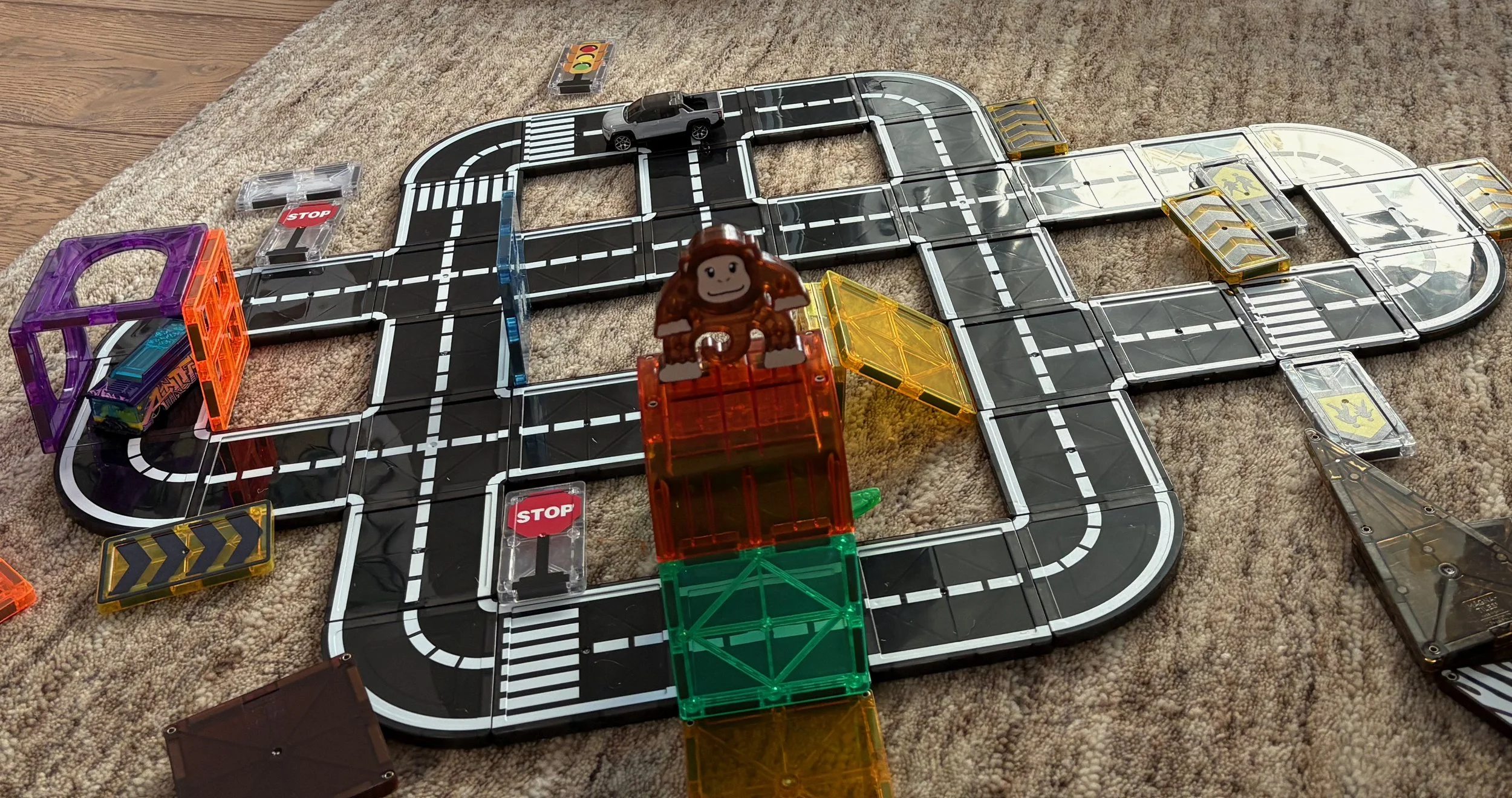
My Magna Tile creation one morning with my daughter — plus a monkey. My daughter added that piece.

So my daughter loves cars. All kinds of cars: monster trucks, buses (she has a fascination with buses!), Hot Wheels, Barbie cars (especially right now), you name it. And, well, cars need tracks or roads, and sometimes when we play together we create roads using Magna Tiles — and she traces the cars, carefully, in her dainty way, around the little track we made, stopping at the intersections, with innocence, glee, and delight. I love her so much: her little smile, her little laugh, the way she focuses on the task at hand, keeping those cars on the track.     

This past year has been something. It’s been not without its challenges – gosh, there have been many – but most of all, it’s been clarifying. As I watched my daughter play with her cars and her roads, it made think of the road itself as a metaphor for the rest of my life: I can visualize the length of my years more clearly, like one long road trip, with firm directions pointing us to the different “kid-stops” along the way. The newborn stop; the toddler stop; the pre-school stop; the elementary school stop; and so on, all phases of my kids’ life that will be different in their own way. (We haven’t gotten farther than the toddler stop yet for kid #1.) But unlike real road trips, these trips are one-way — you don’t get to do them over again, and while you may repeat that same trip with another child (we will with our son), no road trip is ever really the same, no phase the exact same of each kid’s life. It’s a truly one-way trip and that’s it.

“Is it weird the fact that as soon as you feel like you start to get to know this little person [your child], that version of them has already faded?” asked a podcast host recently on an episode about fatherhood. “You’re restarting the clock,” as he put it, each time you have a child. His interviewee, a columnist named Derek Thompson, responded:

“Yeah. Especially now that we feel like we might be done with two [just like we are], there’s a difficult to release sense that you’re watching everything for the last time. That the first time that second baby smiles is the last time we’ll ever see the first smile.... When Kepler helped to invent the telescope, it allowed us to see space in a new way. And in a way, babies are like a telescope for time, because they allow us to measure time in a new way.... Suddenly, the thing that allows you to measure time is your child. And that again, I think, to me, is a nice philosophical wrinkle of being a parent.” 

And so this year has been so clarifying because seeing the road ahead has made me reflect on the finiteness of everything. It has made me reflect more, as Thompson put it, about time. Not necessarily mortality, but just that kids make you realize that there is a specific road to travel — a journey to be had — with bright, radiant signposts everywhere, markers of their life as they develop and grow. And the markers of their life then, in turn, become the markers of ours, not just parents, but as adults, as humans. I can envision the years ahead more clearly than ever before: at 43 my son will probably start Kindergarten and at 53 my daughter will probably graduate high school. I can pick any given milestone and pencil down my age, and close my eyes and at least partially imagine — perhaps inaccurately, because life is full of surprises and I’m not sure what I will look like with gray hair! — where I will be and what life will look like through the lens of my child. (And then once they are grown and leave the home, the remaining markers of the oncoming phases of your life also become more clear, too.)

But the concept of time is emotional; time is not just all we have, the singular thing we want more of and try to hold on to, but, paradoxically, it’s also that same thing that makes life meaningful. It is because it is so precious that we value making the most of it. Thompson further explains:

“You almost begin to mourn the fact that this [a phase of a child’s life] is going to go away even while it’s with you. I sometimes think: wouldn’t it be lovely if we were better at discovering nostalgia in the present? Finding moments in our present that we’ll look back on in the future, and say ‘oh, that’s what made the moment special.”

Although I don’t know what those moments will be as I go on this road trip — this parenting journey — I know it will be full of surprises, each trip’s beauty still to be unwrapped, the challenges unknown. But I know they will all indeed be special in their own way, even with the struggles, and I only hope that I get to experience all of it.

Of course, when I was little younger, even just before I had kids, life still felt like such a journey, with linear stops — college, graduate school, career, marriage, future kids, etc. — on the way from young adulthood to real adulthood. But it all seemed at least somewhat foggy, like I was peering through dirty sunglasses on a cloudy day. Nothing seemed fully certain; it was harder to see. It was less a road and more like a hike — you pick the general area, and then choose which path to take. Some paths end up in the same place, others might lead you somewhere else — like a different career, or even a different partner or a different place you’re living. But this all felt okay, normal even: I knew I wanted to reach the horizon, but I was not really trying to fully see its shape. I was only peaking, not staring far out at the long road ahead, instead focusing on what was right in front of me, one step at a time, making sure I don’t slip on a rock on the beaten path.

But parenthood feels different than the general hike of life — and now I’m looking, thinking, feeling in ways that reflect this change, the road that I am much more clearly on, the horizon not a blur, but almost touchable, tangible, real.

To be sure, parenting is exhausting; it is absolutely relentless and unrelenting. But because each stop on this child road trip only happens once, I want to cherish every single moment, breathe in the intoxicating feeling of loving someone — a child — so hard. When I watch my daughter experience life, I feel pure exuberance. It is euphoric. Yet, what makes it so strange is that, to her, it is her normal: just living and laughing and loving, just existing and being cute and crazy, and demanding every ounce of energy (and patience!) I have. But it’s not normal from my vantage point as a parent. It’s the opposite — it’s magic. She is magic. And my son is too. I just love them both so much. I get consistently overwhelmed by this love.

But feeling this way hasn’t always come easy. I’m not too proud to admit that, actually, it has been really hard. Not the act of parenting itself per se — that’s come naturally. I’ve been around kids, and little kids specifically, my entire life; my first job as a babysitter, my second as a pre-school camp counselor, my third as a tennis instructor for toddlers. (Hello, Tiny Tots at Forest Lake Tennis Club in St. Louis! The night before the clinic, I would cut a tennis ball with a knife, and fill it with candy, and then glue it back together. And then, the next day, I would ask the 3-year-olds if they think I can make the ball explode with my serve. I hit a couple normal serves, and then, pull out this special ball and hit it — and the kids go wild. I am going to try this with my daughter: shh, don’t tell her my secret.) My silliness (or foolishness, depending on who you ask!), and my ability to not take myself seriously — yet still being really serious about teaching and mentoring kids — has made that part of it a breeze. Changing a poopy diaper or cleaning up my toddler’s lunch mess is not hard, per se, it’s just constant.  

Instead, I mean moving from the life of a childless adult to the 100%-always-on-fully-dedicated-dad, from one long adult phase of my life without kids (early 20s to 35) to one with kids that will last exponentially longer. I have always loved my daughter, of course, unconditionally, and have given every single part of me to her well-being since the day of her birth. But for a long time, there were also feelings of “what-did-I-just-do?” and “where-did-my-old-life-go?” The feelings of exhaustion and confusion were, at times, paralyzing — the latter I was glad to write about thirteen days after my daughter was born three years ago. But in my darkest moments, I also felt resentment, too, of this little human who upended the rhythm of my entire life. And I really liked that rhythm! I think about the people in my life whom I love and respect and admire, who had children a decade and a half earlier than I did — parenthood was all they had known as an adult, or, at least, always a core part. My early adulthood was different; my routine well-established to fit my needs and desires. For them, there was really no “before kids” — but for me there had been, and it was a change to work through these different phases so suddenly after solidifying my adult life for over a decade before kids.

But that’s the beautiful part of life: that I get to have so many different phases, to reinvent myself, to seek out physical, intellectual, emotional growth. And so, I know my kids will have different phases — different stops on their road of childhood — but what about me? What about the phases of my life? Surely, it’s not just no-kids/kids that I just described. Life is more intimate, more probing, more nuanced than that. I’ve fully, and perhaps finally, embraced my (hopefully forever) dad phase: it’s awesome and majestic. It’s just beyond words. And the clarity of the fact that my wife and I get to drive this car on this one-time road of parenthood is thrilling and just unbelievably cool, particularly knowing the gravity of each stop, the value of time. But branched off from my core identity of dad, what part of life am I in now? Where have I been? And where am I going? I’m fully in my eternal dad-phase now — and with gratitude and humility, leaning into it! — but if I’m in the dad-phase plus something else, what is that something else?

*****

I initially wasn’t going to write on my birthday this year (before realizing I wanted to write something, to keep the tradition going, even if it would be more simple than my last couple essays). This is because for the last few months I’ve already been writing — a lot. With my son in my arms, rocking him to sleep, or next to me in his bouncer, I’ve been thinking about the phases of my life in ways I never have before.

It feels surreal that I have been writing essays like these for nearly fourteen years, starting when I was 24 with a short piece called “Cherish the ‘Little Moments’” (and blogging in some way since I was 21). It has long been a dream of mine to pull all my essays into a collection, re-read them and analyze them, and mold them into a book that would trace the story of my life up to now. And with the passing of my mentor a few months ago, I realized that the time is now. Life is too short, and being on paternity leave away from my teaching duties would provide the intellectual bandwidth I normally don’t have (even if the physical exhaustion from newborn life remains). Plus, writing my last essay that I posted on New Year’s Eve about growing my capacity to love – the most sweeping and most meaningful essay to me that I’ve probably ever written – felt like putting a “period” on a long phase of my life. This essay interwove everything that I had been building all these years on these digital pages, the culmination of a life philosophy boiled down to one core component that I was finally able to article fully: love. I did not just learn about the importance of love now, of course. It just took me fourteen years — it took me more time — to be able to write about it. After so many essays about kindness, empathy, dreams, the chain of life, the loss of an icon, happiness, and so much more, in some ways, that essay on love felt like the conclusion to all that I had wanted or needed to say (at least for now).

And so every night the last few months I’ve been sleeping and dreaming and waking into this puddle of memories of the past: moments of joy, grief, hurt, confusion, despair, fulfillment, love, and beyond. Through this process of excavation and reflection I have realized that, from 24 to 38, I had already gone through so many phases of my life — not just in terms of my career, or my relationships, or my educational journey, or even where I called home, although each shaped me — but in who I was, how I felt, my evolving sense of living and loving in this world.

I was able to delineate five eras of my life that became the five parts of what I am hoping will be my next book: Foundations (2012-2014); Building Blocks (2015-2018); Reckoning (2019-2022); Becoming (2023-2024); and Legacy (2024-2026). The book is tentatively titled The Unwritten Words: Essays on Love, Legacy, and a Life in Progress — the title taken from the essay that I wrote in 2014 after visiting my grandfather’s tomb for the first time. “Time alone will make you a man,” he once said to me — and that saying, which is the book’s opening epigraph, underwrites the whole narrative. Yet, it includes not just 17 essays from these years, but nearly 20,000 words of new writing from the last few months: part introductions, preambles, and more that provide the connective tissue that turn disparate essays into a cohesive, literary book. Here is the end of the book’s Introduction, titled “Why I Write On My Birthday”:
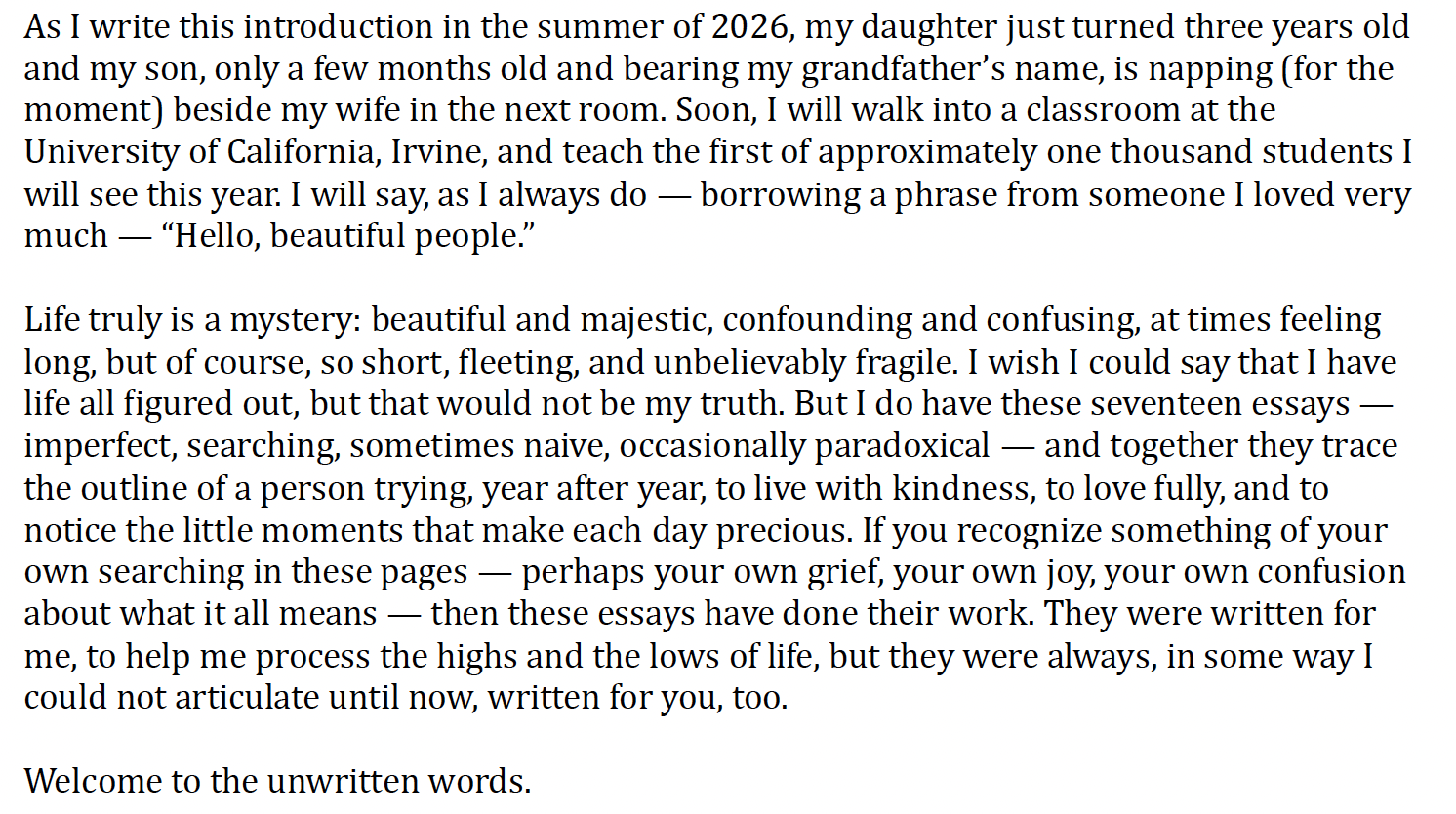


200 pages or so later, I then write in the Epilogue of the book that: “I am still on the path. I am still climbing.” And that remains as true as ever of myself, a person still searching.

But as I reflect on this past year of my life, in my annual tradition of my birthday post, it also feels like I am at rest point in that climb: now out of the fog, I clearly see the parenting road ahead of me. I am ready for it, with great intentionality, with a sense of reinvention of myself that, I think, we must continually do we as we go through new phases of our lives. Awesome stuff in my life happened before kids, and now it’s just a different kind of awesome. As my good friend always tell me — and I am embracing more these days — “it’s a blessing,” and she is absolutely right. Yes, perhaps less freedoms and certainly less time, but it means re-building our relationships with our partners, our friends, and ourselves. That clarity has never been more invigorating as I start my 38th year of life, with deep gratitude in my heart.

If there is anything this past year has taught me — and the past few months revisiting my younger self for this book project — it is this: the idea that only kids have rapidly changing phases of their lives while we, as the adults, remain in one static adult parent phase, viewing it all from the audience, is not quite right. Yes, it’s true that week-to-week, month-to-month, year-to-year, our bodies and life circumstances (usually) don’t change all that much. Almost by definition, “maturity is the point in life which you stop changing so frequently“ — the goal of stability that we all seek. And, again, yes, kids do grow and change so crazy quickly, their lives so different year to year compared to adults, but it doesn’t mean maturity and stability for us means fixed or passive. We, too, can change, grow, expand; even if our material circumstances may stay the same, who we choose to be and how we approach life does not have to. We have to keep evolving, finding new challenges, taking little detours off the road, even if we stick to the general map.

In the aforementioned podcast, Thompson returns to this idea of kids and nostalgia, and time:

“I find myself sometimes looking at myself from the future and saying like, ‘oh this kid’s going to grow up and you’re going to miss this.’ I think that’s healthy. I think having that relationship between the present and the future is actually a very healthy way to go through life.”  

As it pertains to kids, I would agree: this outlook keeps us grounded on that special parenting road. But I also think he’s right more generally about our lives as adults, too. Who can we be? What can we still do? What challenges should we pursue to better our future selves? I’m a dad (and also still importantly a husband, professor, friend, son, and beyond) plus something else that make up the unwritten words of how I exist in the world. Perhaps the “something else” are the curated adjectives in front of these identities: I hope to be dedicated dad, loving husband, trustworthy friend, and so on. But to best pursue these laudable traits, I must have clarity — of mind, body, and even spirit — comfortable with the current phase of my life, doing things and activities and being with people who remind me that we keep evolving, pushing, all the time. As a historian, I’ve always believed that looking and reflecting on the past is incredibly important, vital to our sense of discovery and our sense of self. That is what my book, The Unwritten Words, is in part all about. But so too is firmly living in the present moment through the lens of not just the past, but the future. I think we need a healthy mix of each, and not too much of any. Because if I do find that perfect mix of the past, present, and future in how I live my life, particularly amidst the joy and chaos of parenthood, the next phase of my life (and maybe the next phases of yours) — whatever it will look like, whatever it will be — can still be a great one, perhaps even the best one yet.

 *****

A quick personal note: for all who have been this life journey with me, whether the last few years or all 14 years of writing or my 38 years of life: thank you. Thank you for reading my essays and for supporting me. Thank you for loving me. I hope with all my heart that I get the opportunity to share The Unwritten Words with you one day. Perhaps this spontaneous essay is the start of another 14 years of writing. I can only be lucky. Thank you all again.

-Barry
My Teacher, Professor Morrell

It was a cold, blustery late winter night in New York City, and we had an event featuring a scholar from the University of San Francisco, who had traveled to give a talk sponsored by the Institute of Urban and Minority Education (IUME), under the leadership of Professor Ernest Morrell. The speaker was a former student of his, and I was a little bit worried that the turnout would be sparse because of the weather. As the self-designated cameraman, I took my spot in the back of the room, ready to record. Yet, unsurprisingly in hindsight, every single seat was taken. It was an absolutely packed room—I nestled myself on the window ledge to record. And as this scholar was about to start his talk, someone from the audience blurted out: “Hey, is Dr. Morrell coming?” The speaker responded in his Oakland dialect: “Nah man, Dr. Morrell ain’t here, but he doesn’t need to be here. I’m here because of him. We’re all here because of him.” 

Like so many others, it is impossible to put into words the pain that I – and countless others feel – after Professor Ernest Morrell’s passing. No words can do justice to such an extraordinary human and what he meant to me (and us): his spirit and sheer presence always transcended language, a spirit abundant with so much love, so much kindness, so much compassion and empathy and humanity and beauty. But, as I process his loss, I can only do what he taught me to do and he modeled so eloquently... to write.

Everyone has their own Professor Morrell story – how he, literally and spiritually, changed their lives. I will briefly tell mine.

*****

Nearly twenty years ago, I was a first-year at UCLA – an out-of-state, first-generation student, undeclared in major, and unsure of whether I even belonged at such a prestigious institution. I was doing “okay” academically, but had felt lost and insecure of my scholastic abilities. Somehow, I stumbled into his “Critical Pedagogy and Cultural Studies in Urban Education” class – it changed my life. Yes, his brilliance and oratory were jaw-dropping, bundled with challenging content and a teaching style that sparked my interest in service and educational equity. But it was his presence and love and belief in me that put me on the path that I continue on. I remember going to his office hours, and he told me that I was smart and talented; he told me that I had viewpoints and thoughts and ideas and experiences that had value. Quite simply, he told me that he believed in me. He “saw” me in a way that I had never been seen, scholastically, before. From that course on, I excelled at UCLA, and knew I wanted a career in education, a fire lit that still burns today – I humbly wanted to change lives like he literally changed mine. Like him, I wanted to create programs and research that would meaningfully impact young people. He gave me hope and love; he gave me purpose.

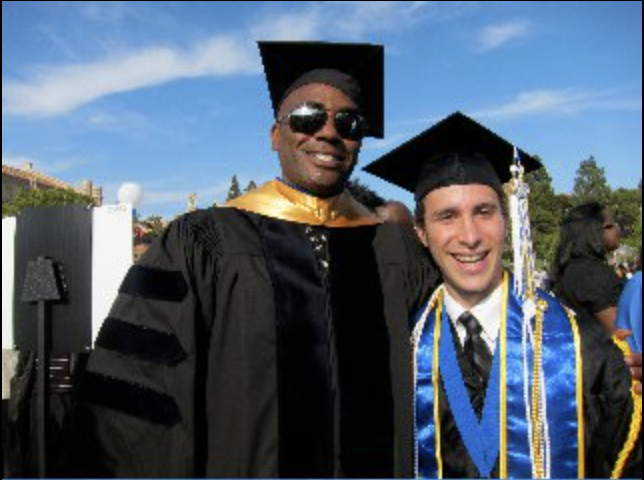
Professor Morrell and I at my UCLA graduation, 2011.

Over the following years, I took another course with him, and visited him frequently in his office. He advised me and wrote me scholarship letters – including for my trip to South Africa – and graduate school letters and just provided sage professional and personal guidance. He inspired me to be selfless at every juncture, and to learn with purpose. He was the father figure to me that I did not have and sorely needed at that moment; an academic powerhouse, but also a role model. He taught me – no, showed me – what it meant to practice love in the classroom, to believe in young people, and dedicate yourself to enriching the dreams of others. He taught me that everything we do has to be steeped in love. No lesson plan or assignment, no relationship, no action, none of it matters unless we do it with the type of revolutionary love he modeled every day.

As I graduated from UCLA, he also was leaving to take the director position at the Institute for Urban and Minority Education (IUME) at Teachers College, Columbia University. As I made the choice to pursue a graduate degree there, I had the unbelievable fortune of working closely with him over the next six years: building IUME (with so many others) from an afterthought housed off-campus to the college’s premier research institute. Year after year, I literally followed him to every lecture, every talk, every event he participated in, recording them as much as for our institute’s digital library as for myself. I would even record our meetings (with his permission), just so I could re-listen – because in real-time, my brain and my heart could not process such wisdom. He continued to believe in me, guide me, lift me up, and just allow me to grow as a scholar and person, mistakes and all (and I made many). And I had the privilege of witnessing his brilliance and humanity every day. His presence was both magnetic and magnanimous; I watched him time and time again, in public, breathe inspiration into legions of people of how to research and teach through innovative, critical, and justice-oriented work. And he challenged me and all of us and never let us off the hook: “don’t just say that this research has future applications for school: develop a curriculum, show them what it looks like!” His belief in the brilliance and power of our youth was almost divine, and he used his position and resources to uplift them, and those who shared that goal. “We must let the youth shine, for they are light and we are nurtured and energized by that light,” he emotionally declared at an event in 2012. “Our youth aren’t an obligation, they are not a cause, and they are not a duty: they are the very reason we are here. They are the reason for our existence – for our lives...” In fact, his entire belief in people was majestic: in one of our first meetings at IUME, Professor Morrell made it clear that IUME was not a “what,” but a “who.” The institute — mirroring his broader work and career — would be about people.

Of course, his groundbreaking scholarship will live on forever, and his accomplishments too vast to namehis genius as a public intellectual is unparalleled. But it is his unbridled genius interwoven with his extraordinary decency and humanity that made him so transcendent and so beloved and unlike anyone who has ever or will ever walk this Earth. Still, despite literally writing the book (literally and figuratively) on progressive pedagogies and youth-centered, critical race-focused and justice-based work, he also eschewed dogmas. He was inspiringly open-minded, not afraid to push back against certain credos or doctrines in academic circles. At the same time that he was an unapologetic and absolutely fearless champion of marginalized students – particularly Black students and communities – deeply steeped in his own cultural history, he also was eager to look beyond the confines of race and identity, too. His diverse set of colleagues and advisees spanned every background and perspective. He had no agenda other than love – and the type of revolutionary love, as he both preached and practiced in public, only exists in a universal form. 

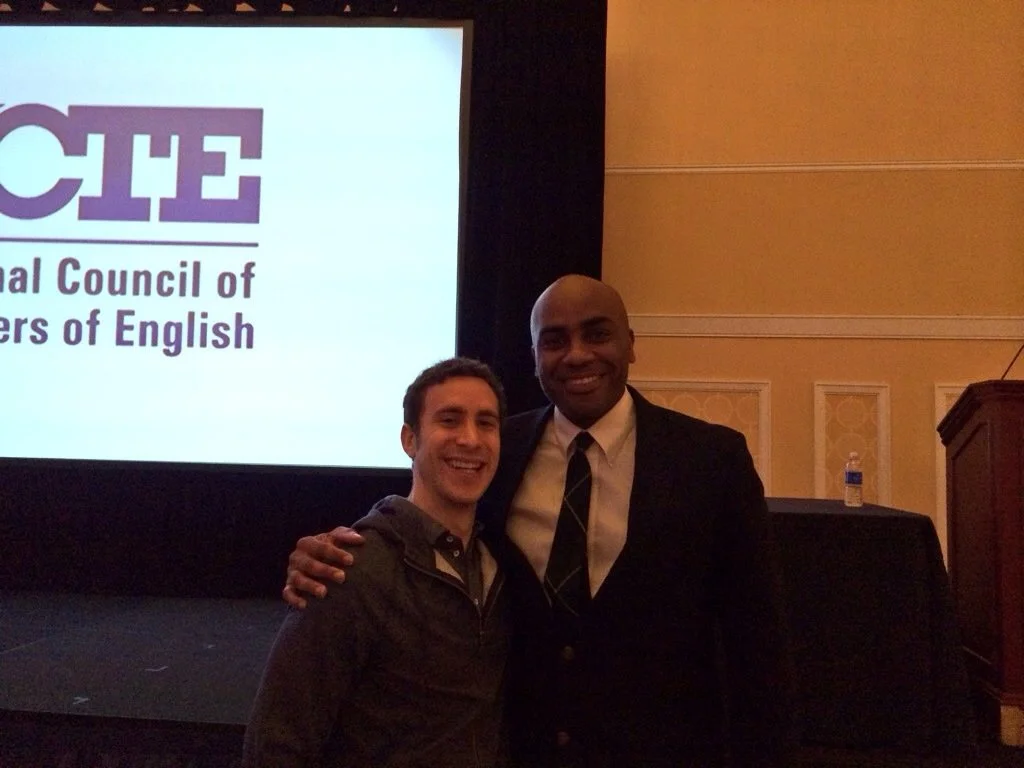
Professor Morrell and I at the 2014 NCTE Conference.

But it was what he did in private that spoke to his uncommon magnanimity. For all his accomplishments and genius, he was uncommonly modest, sincere, kind, and patient. Even, at least as I observed, quiet and gentle in his own way – Professor Morrell, ever the scholar, ever the writer, ever the thinker. A true renaissance man that, to me, was this giant of a person in every sense of the word: a beautiful soul whose benevolence should not belie his ferocity as a scholar. He was a giant of all giants. And I observed him time and time again treat all people, every single person he interacted with, with remarkable dignity. At IUME, in the quasi-“Ernest Morrell/IUME historian” that I became during those years, I bore witness to his beautiful humility, a rarity in academic circles. Behind the scenes – as so many have testified about him – he served as a pillar for support for countless students, giving every part of himself in innumerable ways. He went beyond maximum capacity every day of his life, in private, to champion those he believed in. And, gosh, he believed in so many. He believed in all of us. This is why his legacy will always be larger than life. Like his former student said that rainy night in New York City, we are all here because of him.

As he left Teachers College to pursue a new journey at Notre Dame, for the first time in 11 years, I was either no longer at the same institution as him or working with him professionally (he was on my dissertation committee until I defended in 2019). Now from afar, I saw him pursue new lines of scholarship around Catholic education, in ways I did not expect – again, showing that he is full of surprises and ingenuity, and faith. I realize now that he was always a man of great faith: he had faith not just in God, of course, but in the world. Faith in the power of love, faith in people, faith in all of us. I will forever be gratitude that he had faith in me.

There are students and friends and colleagues who know Professor Morrell far better than I do, particularly in his recent years at Notre Dame (and of course his early life and career pre-UCLA). I was not privy to the details of his long battle with cancer, other than knowing that he battled it with his trademark grace and courage. He kept going, and fighting, and writing and thinking and inspiring and mentoring and loving. I cannot fathom the strength – and faith – it must have taken to carry on. But yet he did. 

*****

When I moved back to Los Angeles in 2017 (although I was still working on my Ph.D. at Columbia), I needed a job. With no L.A. network, I wasn’t sure where to look or turn. But, somehow Professor Morrell was, again, there for me. Just like when I first moved to New York and he offered me a much-needed position at IUME, and when he soon after connected me with a then-new professor who would become my primary advisor and mentor, he was there for me again in L.A. As I eventually learned, he made a call to a former student of his – now an administrator at a local community college by me – and told her (as she recounts it now) “take care of Barry.” That call put in motion opportunities that I can trace to my current position.

As a lecturer now, I teach about 1,000 students in 12 courses each year. And every single day I think about him: I borrow his mannerisms —"hello beautiful people!” – and share his scholarship and model my teaching after him, but more than anything, I try (imperfectly) to exist in the world like he did, in joy, in hope, in love. He taught me, during the most formative years of my life, more than any person, how to grow my capacity to love. He taught me that education doesn’t have to be rigid or stingy or impersonal; he taught me that our jobs as educators, particularly as faculty, is to be gate openers, not gate keepers. His personal and professional impact on me is so profound, it is unquantifiable. Again, there are other people – special people – who knew him much better than I did, in much closer and much longer working capacities than me. I was only ever his student, but it is a title that I will always hold with reverence and gratitude for the rest of my life: that I had the great fortune to be taught, mentored, believed in, and loved by Ernest Morrell. They say a person should never have heroes, but he will forever be mine.

I cry and I mourn for your passing and all that you meant to me and to your family and to your students and your friends and your colleagues, and to this world. Like so many posts and sentiments, I will try hard to honor your legacy every single day and to make you proud. I love you more than I can ever express. As you once pronounced: “It is our work with others that make us eternal.” You will always be eternal. I love you forever and may your beautiful soul rest in peace.

A New Year's Resolution: Growing My Capacity to Love

“You rarely have time for everything in this life, so you need to make choices. And hopefully your choices can come from a deep sense of who you are.” —Fred Rogers

THIS PAST SUMMER, it was one of those mornings—I was feeling a little groggy, my mind and heart a bit worn-out from the everyday grind of a morning routine with a rambunctious toddler and an overflowing inbox. I had not yet awoken my daughter, and as I usually do, I sat down to browse the various news outlets while I crunched on my cereal. I stumbled across a long-form essay in The Atlantic about a mother and her son after his severe brain injury; I am not sure what compelled me to click on an article seemingly so far out of my intellectual comfort zone. But I did, and when I finished, I cried: I just broke down, sobbing while my wife—who now joined me downstairs with my daughter—rushed to my side, as if something was wrong. My tears continued in her arms. I was not even sure why I was crying, but for some reason I was, unexpectedly thrust into a deep reflection about life and mortality—and love—at 7:15am on a weekday morning. After I regained composure, I jumped to go play with my daughter: to kiss her little cheeks, squeeze her tightly, admire her smile. The banality of the morning immediately faded and I admittedly felt a wave of guilt flow through me for even feeling the tiniest bit of “blah” upon waking.

My family and friends know that I am of the sentimental type. But for some reason, this beautiful essay made me feel in ways I had not in a while. There is too much weightiness and beauty in the essay for me to accurately synthesize it here—it is stunning writing—but in short, it is a very sad story of a teenage boy in the 1970s who was struck by a car, survived, but only in what we refer to (albeit problematically as I learned) in a vegetative state, with minimal consciousness and little to no use of his body. It is indeed a tragic story, filled with rich discussion of neuroscience and brain injuries, all topics that I am (fortunately) not very knowledgeable about. Yet, the story wasn’t really about tragedy at all, actually. It was a story about unconditional love: a mother’s love and a brother’s love and a re-imagination of love itself.

Most of all, it was a breathtaking story about a few people’s profound capacity to love.

The rest of that morning, I did not know what to think, or what to feel, or how to make sense of any of what I read. But eventually as I settled myself into the rigidity of my daily routine, I realized that my response to reading this article was the most “human” I had felt in a long time—the full rush of emotions of sadness, grief, gratitude, kindness, and love besieged my heart and my mind. But, above all, for the rest of the day, I could not stop thinking about this one particular concept emphasized by the mother in that essay: her extraordinary capacity to love.

*****

THIS LAST YEAR AND A HALF has been wild and challenging, if not also beautiful: my daughter is now over two and half years old, and she is a supremely happy little girl with a smile and laughter that brings me unbridled joy, even amidst the exhaustion and new challenges of the “terrible twos.” Still, our lives have settled into a routine that two years ago would have seemed foreign amidst the chaos of a newborn. This routine—even as I still search for my own equilibrium of happiness—has allowed me to accomplish long-awaited goals and seek out new ones. My book, Strength through Diversity, which took me well over a decade to research, write, and then publish, is finally available to the world as of last January. This dream achieved and prodigious project finally behind me, plus being home—a lot!—taking care of my toddler, I have been able to think a bit more on my personal growth. Those who knows me are familiar with my physical health and wellness goals, where I’ve been challenging myself in the gym more than in years past. I’ve been reading consistently again, challenging myself intellectually as well, trying to keep my mind sharp and elastic. More than ever, I’ve been reading and listening to ideas that challenge my politics and preconceptions, the things I thought I was right about or to seek better understanding of our world that seems to be aflame. It has been stimulating weaving new exercise workouts with new books and different voices. So, while I worked on my physical and intellectual growth this year, until the article in The Atlantic, I had not thought about my emotional growth much at all. Have I expanded my own capacity to love? Can I expand it even more?

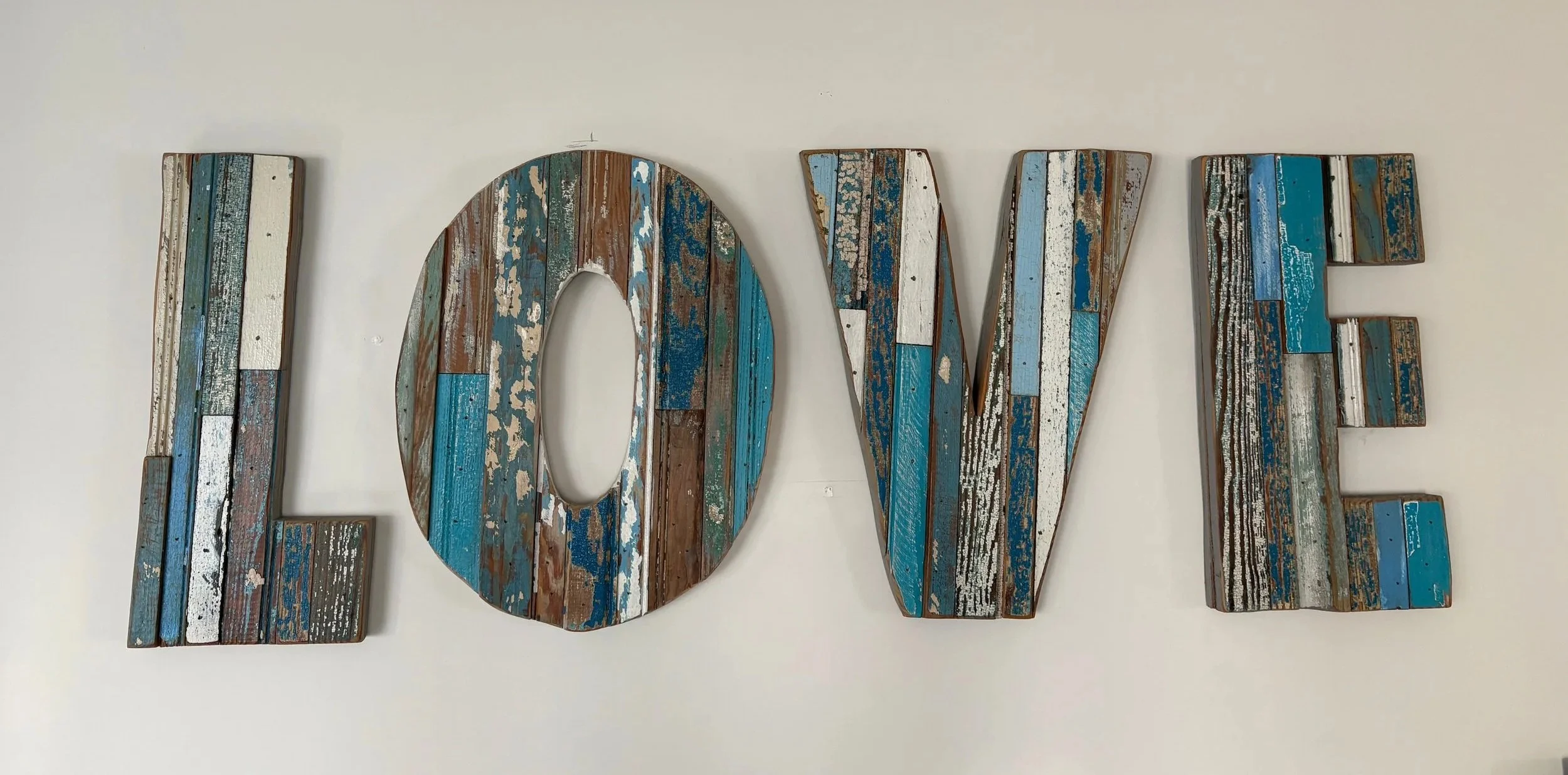
Our chosen home decor right above our living room mantle in our home.

I actually thought about this same question, if more rudimentarily, a few years ago when my wife was pregnant. We thought we had always wanted kids, but at the same time, we were not 100% sure, either. Our lives already felt so full in our partnership and I loved her so much—loving my wife gave me all the “purpose” and joy I could ever imagine. So, when she did become pregnant, I had this constant worry: could I find more room in my heart to love another being just as much? The answer, of course, was “yes,” and while it seems silly in retrospect, the paradox is not: where you feel your life is full and you do not need to seek out more love, but then when you feel more and you grasp it—you realize you are better for it. This doesn’t have to be a child; it can be a friend or coworker or a neighbor, or maybe even a stranger. And all of this doesn’t mean you stop loving those who you loved before, but you just somehow find more room in your heart. Your heart grows like one’s muscle or mind. This love makes us fuller, it makes us more ambitious, it makes us keep striving to be better for this additional human who is now part of our orbit.

Of course, this is not the first time I am posturing about love more generally—I know it’s not yours either. Nearly a decade ago, I wrote about the importance of love in maintaining a connected society; no amount of laws (or law enforcement) can exist without a belief in a creating a social fabric, underwritten with empathy for others. But I have realized in the decade since that in order to be “driven by love” as I wrote then, we need to do two things: one, define it and then act on it in much broader terms that we often do; and two—the topic of this essay—tangibly grow our own capacity to love so that we feel its power, its radiance, its ability to indeed make us better humans.

What does a more holistic definition of love “look” like? “When we think of love, we think of romance and happily-ever-after fairy tales,” writes Suleika Jaouad. In her story about a friend’s illness, she explains how love is “the radical power of seeing, understanding, and showing up for another human.” She quotes a famous British novelist who further writes that the word love “is fatefully associated with romance and sentimentality that we overlook its critical role in helping us to keep faith with life at times of overwhelming psychological confusion and sorrow.” Or, more simply, as one of my remarkable best friends told me, “you love differently” in different ways to different people—and in different moments.

It is through this definition of love that we must grow our capacity to obtain more of it, not just in our relationships with those we already “know” we love like our friends and family, but in our everyday interactions with strangers and the world. What are the stories, the movies, the music—and the people curating these forms of media—that challenge us to expand our capacity to love? Who can we can listen to or read from or inquire about that challenge us to love people and topics, not criticize or even hate, that we do not fully understand? How do we create little moments in our lives that can create larger shifts that make our hearts truly smile and make us feel in ways that bring out our shared humanity?

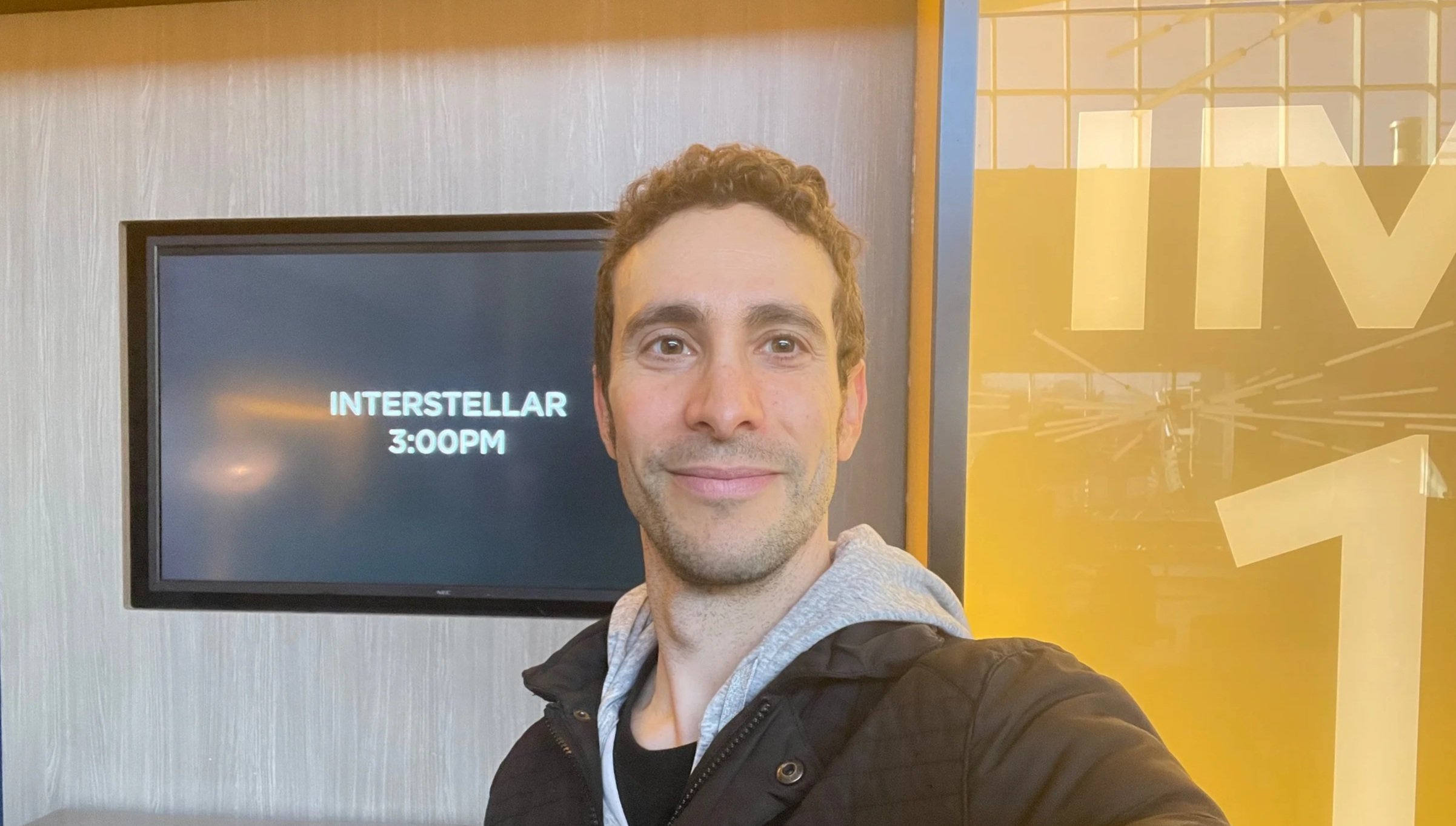
A quick selfie before I walked into the theater with my wife to view Interstellar, this time with a daughter of my own.

I think about when I saw Interstellar for its 10th anniversary in 10mm IMAX with my wife last fall (my absolute favorite movie of all time). I was teary-eyed nearly the whole movie thinking about a father’s love for his daughter and the concept of time passing. As The Bulwark wrote regarding its re-release: “Interstellar is a movie that posits love being a force like gravity that can transcend time and space and dimensions to save humanity from its own destruction... I have come to love the film unreservedly for the way it deals with family and parents and children and love and every time I watch it now I walk away a weeping mess.” I did that night, too, and I fully agree—and I want more of that feeling, all the time.

One of the best things about being a parent is watching your child learn to love and understand its eternal power. My daughter’s capacity to love is endless—it has no boundaries. It is beyond beautiful to see how she grows her capacity to love literally every day: her “friends” (i.e., stuffed animals gifted to her) who she snuggles with wonder, her family who she endearingly will call out for with joy and point to her chest when they say “love you,” strangers she meets who she blows kisses, and even herself when she feels joy and smiles when she accomplishes a task. It’s all absolutely magical. Love is so deeply central to her young existence in this world.

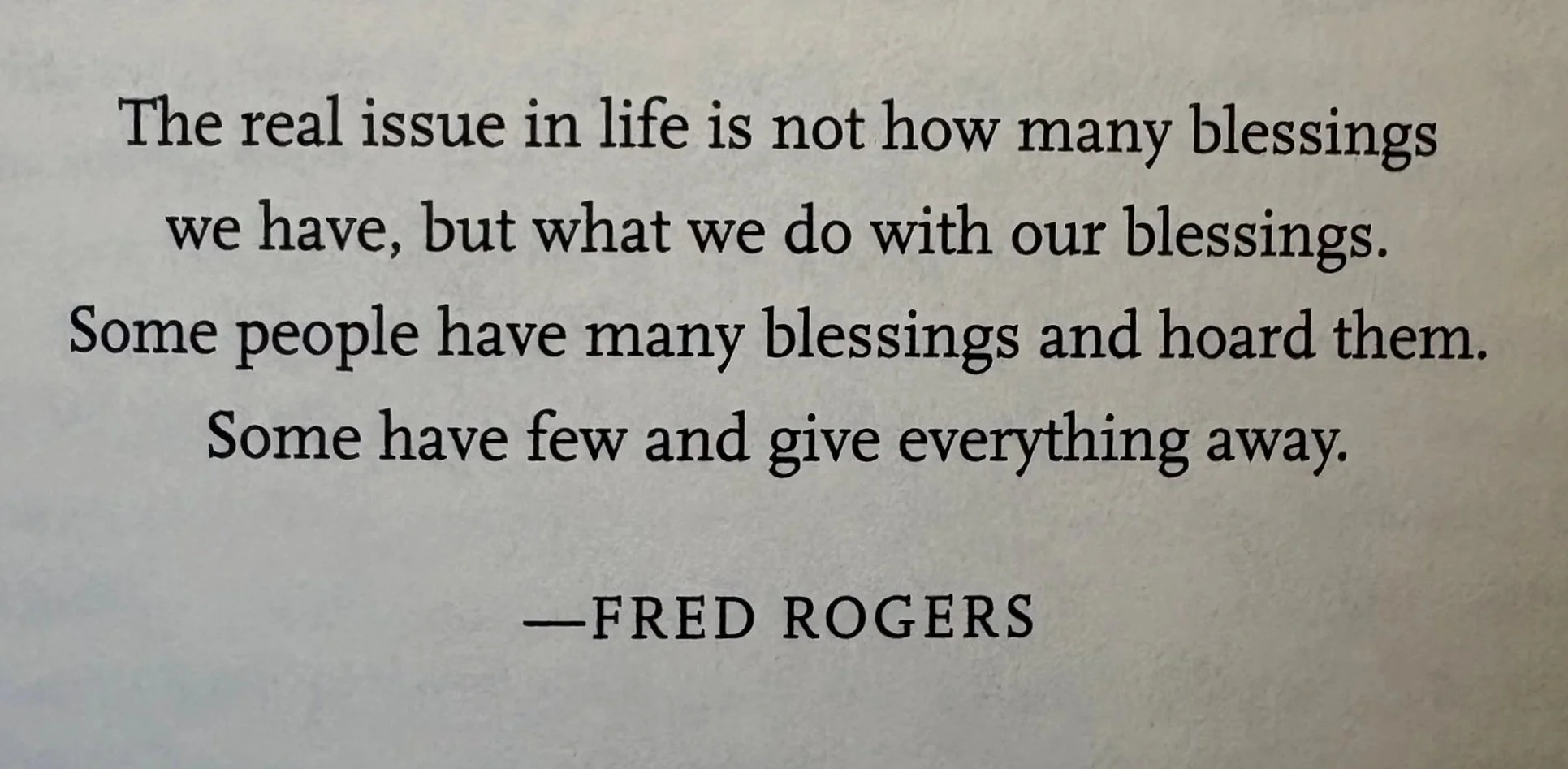
A quote that perfectly encapsulates my grandpa and my grandma, who carries on his (and continues her own) legacy.

But, notably, examples of the capacity to love are not exclusive to a parent and child. I am reminded of my grandfather and his longtime involvement with the Meals on Wheels program (which has been in the news due to funding cuts affecting seniors all over the country). Meals on Wheels is a federal program—part of the Older Americans Act passed during the Great Society programs of the ‘60s—that provides critical food service to low-income senior citizens who are ill or unable to prepare food themselves. Volunteers deliver food but just as importantly provide wellness checks and social connection to these seniors who are isolated at home. My grandma tells the story of how, while working as a secretary at her synagogue—which helped distribute food in her neighborhood—asked a family member of one of the recipients how the deliveries have been going. The family member replied that it was going fine, but the woman receiving the meals wanted to request that it always be the “tall, handsome man” deliver the food, as opposed to other volunteers. (This handsome man was her husband, of course—my grandpa—but the person speaking did not know that!) When my grandma asked why him, the person said: “Because he doesn’t just deliver the food, but he comes in, puts the food in the refrigerator, and stays to talk and engage in conversation.” She went on and on—according to my grandma—about how this man was so friendly and generous with his time. This elderly woman felt loved in that moment, and it really made a difference in relieving her constant loneliness. Despite tremendous hardship throughout his entire life, my grandpa’s capacity to love was second to none: he thrived on helping others and saw the humanity in every single person. He loved life, in part because he loved people and their stories.

What about the role of schools in growing students’ capacity to love? As a professor of education who teaches about 1,000 students a year, this is a question I think about every single day. While higher education has its many issues, at a time where universities are under unprecedented attacks, I witness every day the way in which students learn real cognitive skills of how to assess information, think critically across different viewpoints, craft arguments, and collaborate with others; I also witness how it is “good,” in my estimation, that young people are exposed to new ideas, one course, one professor, one reading, one classmate at a time across disciplines and fields (even if we could use more ideas). But, part of what happens in college is that—in this process of learning and stretching our intellectual capacities—is that, if we do it right (and we don’t always, to be sure), we also build empathy, learn what it means to extend grace to others, and, yes, ultimately, grow our capacity to love. In my classes, this is central to what we do: despite commentary otherwise, research convincingly shows that, on average, more empathetic people experience more professional success and greater well-being.

Other examples about growing one’s capacity to love abound at the K-12 level. One just flat out super cool program is The American Exchange Project, a student exchange program not based on some far-off country, but within the United States. “Urban and rural teens swap hometowns and are shocked by what they learn about each other,” reads the headline about this program in the Los Angeles Times. I love this program so much because it directly pushes in kids’ natural curiosity, wonder, and discovery to the forefront, and pushes out stereotypes and misconceptions that they’ve grown up with and internalized (often through media). It expands kids’ capacity to love others—to form meaningful bonds—across racial, religious, ethnic, socioeconomic, political, and geographic divides within our diverse country. As I write in my book, I think we have to be curious about each other, but too often, our innate curiosity that we all possess is pushed aside: we do not even attempt to grow our capacity to love. Our “hearts” become static, and outside our immediate circle of family and friends, we then begin to perversely find entertainment in the suffering or demeaning of others. We know scientifically that we have to expand our mind to keep it cogent, and that we have to keep challenging our muscles to keep them strong. But I have come to believe that our “hearts”—our consciousness as humans, perhaps our souls for those who are more spiritual—also must be exercised, too. It, too, can grow and contract like our minds and our muscles.

*****

SO, WHEN DID WE stop trying to expand our capacity to love—stop listening and reading and watching things that would expand this capacity, as opposed to restricting it or even hoarding it for ourselves? And why? Of the dozen or so books that I’ve read since January, one of the most provocative (even if a bit dry!) was a book called The Upswing by renowned political scientist Robert Putnam. Putnam and his co-author argue through a litany of research how America has moved from a period of selfish pursuit in the Gilded Age of the 1890s to common purpose in the mid-1900s back to selfishness in recent decades, or, as he puts it, from “I” to “We” back to “I.” And, as a result, we are the most economically stratified, politically polarized, socially fragmented, and culturally divided since the Gilded Age. This lack of cohesion and care for our fellow citizen, among many things, foregrounds the inability to solve major problems. I am further reminded of my graduate school advisor and her beautiful tribute to her dad after his passing, in which despite his politics differing from hers, he understood that we all depend on others in this fragile life. 

And so here we are in the present—and I am struck how arguing for growing one’s capacity to love seems so antithetical to the news and to the words of (seemingly) so many popular commentators and often our representatives. With the avalanche of information at our fingertips, politics has become pop culture and entertainment: it’s ubiquitous. While I hesitate to wade into the fraught political arena, it’s hard not to do so when our all-consuming political culture has become one of cruelty, not love. Certainly, politicians have always decried their opponents with the most vile insults dating back to our founding—they are “in the arena,” as Teddy Roosevelt once proclaimed—but attacks on common folk, on each other, by each other, just feels different. There has been a sharp attack on empathy in our politics, where both cruelty and even the theater of cruelty is applauded, even desired. It seems like the more suffering that a person can impart on those “we” (those in positions of power) are not “supposed” to like—the immigrant mother in fear of being separated from her family just like her husband or the trans student being bullied into suicide or the poor rural grandmother in Appalachia unable to put food on the table—the more notoriety that person gains. Unfortunately, to denigrate a person or group is much easier—and certainly more profitable, whether through dollars or influence—than the internal work of growing your capacity to love. Because in the “attention economy,” our “likes,” our listening, our scrolling is monetized, and nothing grabs attention like outrage, conspiracy, and spectacle, whether it’s true or not. Love, on the other hand, does not have that same affectation. 

To be clear, this is not at all about policy, even if and when I sharply disagree. As a historian who has studied public policy, I am not naïve to believe that love can always be the guiding light in our policy-making. There is a myriad of practical, legal, financial, ethical, and even safety considerations within every policy decision. Life is rarely fair, and we must maturely balance our empathy with what is possible. The world is exceedingly complex, and too often we flatten these issues—just like we flatten the depth and complexity of every person. After all, more than 90 million people did not vote in the last presidential election: more votes than either candidate received, suggesting, at least to some degree, just how many Americans did not find themselves reflected in either option (many of whom undoubtedly share these values of decency and care). I think we all can, from every “side,” do better in extending much more grace and less judgement within current policy disagreements. (That includes me, too, as my goal next year is also to be more open-minded and recognize there is more uncertainty than we want to admit!) Instead, my disheartenment is about the entertainment we gain from seeing people, our fellow Americans and humans, suffer or be demeaned. Because even if you support a policy, for any number of personal beliefs or practical reasons, that might cause harm to some group, you advocate for it with a heavy heart—not with glee and celebration.

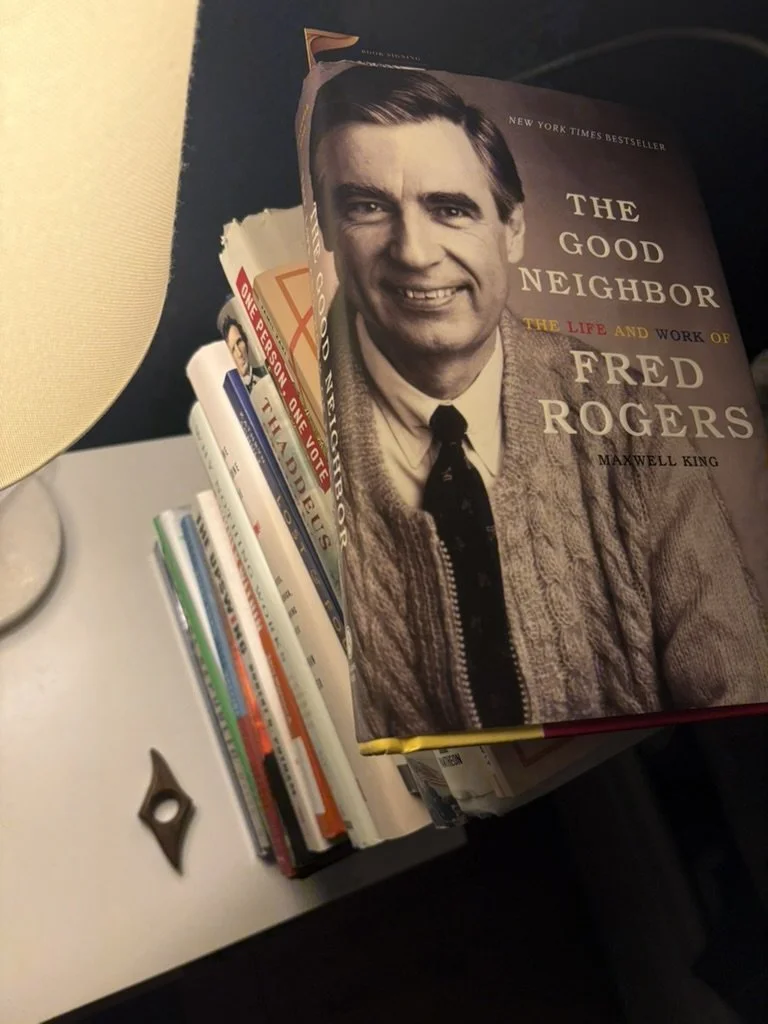
My nightstand stack of books I read this year. (My daughter is obsessed with Misters Rogers’ music, and so I decided to pick up a biography of his life.) As you can see, this book is on my mind!

In short, our political culture has become about grievance, hate, and fear: of the opposite of “love thy neighbor” and recognizing our fellow American as worthy not just of common dignity, but the love of anyone, whether a spouse, parent, friend, or representative. And because our politics (and our partisanship) have become so central to our everyday existence in the “rage economy,” we then internalize and normalize these behaviors. Quite simply, ­I believe everyone deserves to have love and to be loved. I don’t want to hurt anyone, I want to learn to love everyone—to grow my capacity to love—particularly those who I do not understand. Of course, there is a “moral line” that I have (and I think we all should have) about treating everyone with decency—a line, that at least as I believe, is crossed by our leaders and commentators that veers into racism, antisemitism, misogyny, homophobia, and so much more. How, or if we even should, bridge divides with those so clearly (to me) over our moral lines, who dehumanize others, is a question I struggle with, and do not have an answer to. What I will say is that, unlike hate, to love another person takes courage and bravery; it takes inner strength and fortitude. All of this is why love is among our highest virtues: we strive for it, even if we cannot always perfectly attain it. Of all the books I read this year, my favorite is my current one—a surprisingly moving and thought-provoking biography of Mister Rogers, who understood that the most important affirmation we can teach children is to say “I love you” to others and, most of all, to themselves.

Ultimately, we’ve all been conditioned to see politics, and well, other people different than us, as zero-sum: the suffering of another leads to our personal benefit. But is this what we want our politics to be—both our “political” politics as well as our personal ethos? Is politics just the “organization of our hatreds,” as Henry Adams once exclaimed? Of summoning fear and resentment? Or, is politics about bridging divides and bringing people together? About solving problems and helping others pursue a better life? As the popular (if at times controversial) New York Times podcaster Ezra Klein further explained, if it’s the former—a way to build a dislike of groups that I am not a part of—then I (too) have no interest in making that part of my civic or social life. I don’t want to actively push away the most essential component of life—my capacity to love—for any reason.

To be sure, people across our diverse country have a range of personal beliefs, which are deeply shaped by each person’s unique experiences. I grew up in Missouri, lived in New York, and reside now in California. I spent time in South Africa, and read everything from the New York Times to The Atlantic to the Wall Street Journal, to even the City Journal. I teach over a thousand students each year from all walks of life, backgrounds, and identities, from urban, suburban, and rural areas. But as I’ve grown as a professor, I realize that I find so much fulfillment and richness in learning my students’ unique stories. This goes hand-in-hand with my fascination in trying to challenge my worldview, learning different ideas from people and from spaces that present the world differently than I have come to understand it. Social media can distort our frames of reference: we assume that the way we see the world, and the events that happen (and events that do happen but are not presented to us by the algorithm or the certain outlets we follow) are the ways that everyone sees it. But that is just not the case and it’s really, really, really hard to escape the algorithms that entrap us all. But, I believe that if we are more purposeful about growing our capacity to love, we can escape that trap—and, I believe, reap the benefits in return.

***** 

MY FAVORITE PART OF life is the many textures and variables of it—the waves of emotion that make us feel alive, the feelings of genuine joy, whether through friendship or family or simply self-satisfaction of “duty” after a long day. The author Katheryn Shulz makes the point that there is a difference between happiness and fun; too often, we only seek out moments of fun, but those moments of fun are always fleeting. They do not last. They are finite: a night out with friends, engaging in our favorite hobby, watching a comedic YouTube clip. These can all lead to important (and necessary) moments of fun—and we should strive for more laughter and this type of fun that I could really use more of!—but, at the same time, it is impossible to fill every moment of every day with “fun.” Days are just too long (even if the years are absolutely way too short). Instead, if we can find contentment in duty, satisfaction in the “little moments” that are laced with love as I wrote almost a decade and a half ago, our hearts and souls can become closer to feeling satiated.

I can relate to this idea a few weeks ago. It was late on a Monday night. I was still exhausted from the previous week. Yet, there I was, prepping food for my daughter for the week ahead, listening to music, hot food on the oven and stove, the glass containers queued up in a perfect line on the counter. When I put it all in the fridge, I felt fulfilled in my heart, because it was my duty as a parent—as a father—to make sure my beautiful daughter, whom I love more than I could ever express, had food for the week. I found so much joy in that (and great gratitude that I have the resources to provide these meals, too). A rush of deep satisfaction overcame me, perhaps a quick jolt of happiness, too, even if what I was doing at that moment of exhaustion definitely was not fun. If my capacity to love was a meter, it would have ticked up the tiniest notch.

Coming full circle, it’s not always fun to grow one’s capacity to love; nor is it always easy (or, admittedly, even always possible). I readily confess to not always taking my own advice: seeking the confirmation of my biases (which we all have) instead of my intellectual growth, mistaking my contentment for what actually was (and often still is) my stubbornness, and falling prey to stereotypes and the flat portrayals of strangers and groups. I think about my inspiring friend who reminds me—teaches me, really—that hate is too strong a word, and that we can disagree while staying in the spirit of love. I strive to be better, to follow her important example. Again, all of this is hard and all of it requires a humility that the enigmatic emotion of love promotes. Because at the end of the day, I do believe that growing our capacity to love can make us feel more fulfilled as humans. Our spirits feel healthier, our lives more enriched, our relationships deeper, and our souls more gratified. Love is what we live for. Shouldn’t we try to seek as much of it as we can?

When I think about what 2026 will entail, I am reminded of my need to greatly enlarge my capacity to love in unprecedented ways: my wife and I will welcome our second child in 2026, a son, who will require of me more love than I have ever given in this life so far. (Fittingly, he will be named after my aforementioned grandpa.) It won’t be easy, and yes, at times, it won’t be fun—and yes, referring back to my earlier definitions of love, my love for my son will not only be hugs and kisses, but “showing up” for this tiny human and keeping the faith in times of what I know will be “overwhelming psychological confusion.” But I’ll also do my best to model to my son and daughter what it looks like to love others, even—and especially—when it’s hard. At the end of the day, love is the universe’s most precious gift in the larger gift of life. I plan on trying to open that gift every possible moment I can, in my all interactions and all my endeavors, for as long as I can. That is my noble goal for the upcoming year. I hope it’ll be yours, too.

A book about the past, for the future: living in a multicultural world

 
LISTEN TO ESSAY
Barry M. Goldenberg
 

Often it is the unexpected, the unknown surprises, that create the most enduring meaning in one’s life. As I recount in the preface of my new book, I vividly remember stumbling upon an old, grainy documentary about a school that existed during the late 1960s and 1970s in New York City. Little did I know that this moment of happenstance—either through good fortune or fate—would forever alter the trajectory of my professional life. For the last twelve years, I have immersed myself in the history of this school, theorizing and learning about the intersection of love, multiculturalism, and education that formed the core of this institution. As I was developing my educational philosophies and teaching students of my own, learning about this school was both formative and inspiring in those efforts. And all the while it became my dream to faithfully share the story of those who created, supported, attended, and taught there. This school was called Harlem Prep, and finally, I am elated to share that this dream has come true: on January 14, 2025, Strength through Diversity: Harlem Prep and the Rise of Multiculturalism, will be published by Rutgers University Press and will be available to purchase worldwide. Learning about this school has changed my life—both my views as an educator and how I exist as a citizen of the world—and I hope it will change yours, too.

*****

It is no secret that we live in a fraught moment in time. Sweeping technological changes are on the horizon, existential threats of health and climate abound, and most of all, the political strife, division, and polarization within our communities has seemingly deepened. I am not foolish enough to suggest that I have any answers to these complex challenges, but when I think about this book, I see the story of Harlem Prep as part of a path forward—a path steeped in collaboration, hope, and the realities of living in a diverse world. History does not provide a prescription for the future, but it can provide a blueprint.

On a purely educational level, there is much we can learn from Harlem Prep’s example. For one, the kindness and love on display each day at Harlem Prep are qualities that are desperately needed inside schools—they are the bedrock of learning and engagement. Harlem Prep had those qualities in abundance, and this book interminably documents the practical ways in which kindness and love manifested in the school’s make-shift classrooms and in the actions of its staff. I am confident that we can all learn from their example.

And two, it has never been more important—or more necessary—to re-imagine education. All across the country, the status quo of K-12 schools and colleges are being disrupted, with online classes and different modes of learning thrust upon educators, administrators, parents, and our students. Arguments about curriculum, books, and a return of cultural warfare in our schools has risen (again). Instead of coercing students to learn one way, we must create spaces in which enrichment, creativity, and joy are in abundance; we must meet students where they are based on their various skillsets, their interests, and more than ever, the ways that they learn best. We must also support communities and uplift them—not tear them down. While 1967 or 1973 is certainly not 2025, Harlem Prep did something similar, even if in a different context: the school sought to create a rigorous educational program that directly spoke to the students it taught and the community it served. Most students had been “pushed out” of his or her high school, and they came to Harlem Prep with different abilities, different living conditions, and vastly different ages, political orientations, and lived experiences. Instead of being intimidated by this diversity (and weighed down by constant fiscal uncertainty), Harlem Prep embraced flexibility in its pedagogy, policies, structure, and more. Harlem Prep was able to foster the academic achievement of many hundreds of students in a turbulent 1960s and 1970s era. Although our present-day context presents a number of very different obstacles, we are still tasked with a similar challenge: to embrace flexibility and ultimately, to re-imagine student learning beyond the same methods (and trite school processes) that we have traditionally accepted in decades past. As we all envision new models of learning across the country and innovative ways to structure a school to meet the changing needs of a technological future, perhaps we can seek inspiration—and create modern adaptations—from Harlem Prep’s example here. Sometimes, we are too eager to try out “new” untested ideas instead of looking to the past at ones that we know have proved successful.

We can also look to Harlem Prep in terms of reclaiming multicultural education today. After all, our schools have never been more diverse: racially, ethnically, linguistically, socioeconomically, religiously, and beyond. We have to prepare our children for the diverse world in which they will inhabit in the future, not the past. From 1967 to 1974, Harlem Prep’s leaders recognized the importance of this goal, but in an even more-diverse society of 2025, this goal is even more vital today, in every city and every state. Classrooms are full of talented, inquisitive students who learn differently and who are full of unique life experiences. Harlem Prep’s entire educational philosophy was premised on the fact that this diversity was the school’s greatest asset. We must have a similar mindset today. Our demographic realities demand it. Despite having a majority Black population, the school’s multicultural philosophy taught students to appreciate, at least on some level, with people of all ideologies, religions, and racial/ethnic groups. The school also emphasized not just racial, religious, and political diversity through its integrated teaching staff, but diversity within racial/ethnic groups, as well. To be clear, Harlem Prep was no moderate institution; school leaders emphasized Black cultural pride and existed as a foil to the racism happening in other schools and throughout the country. The school was filled with cultural celebrations and Black Power insignia. But school leaders also knew that in a diverse country, it was imperative to prepare young people to live amongst such diversity, and never to demand uniformity of one viewpoint or ideology.

Thus, as educational stakeholders, we should rely on this beautiful diversity inside our classrooms and in our communities. Our educational institutions must be a guiding light—not just in theory or in empty rhetoric, but in practice. What does that actually look like? Strength through Diversity provides a robust example for thinking about how to implement multiculturalism in every facet of a school (and not just tokenized curriculum). From its physical space, to its administrative structure, to its embrace of student divergence, to its teachers and their pedagogy, to its community engagement, it is rare to have such an in-depth portrait of every component of a multicultural school. This is a “usable past,” as preeminent historian Eric Foner once wrote.

However, Strength through Diversity does not just provide ideas for bettering our schools through multicultural education, but toward a greater vision for societal progress through a genuine ethos of multiculturalism. Harlem Prep’s leaders understood a need for a new political fabric. Too much of our personal ideologies, and even our relationships with others, have become exclusionary—not inclusive, even if we claim that they are. Understanding each other, hearing each other out, and finding a respect even amongst real differences is, in my opinion, what we have to do today. It is the only path forward; the only way toward creating a future in a country that is increasingly diverse. We cannot claim inclusivity if we only mean inclusive for some: inclusive if someone matches our exact viewpoint, has our same race or ethnic background, or is from the same social class. A politics of multiculturalism is a politics of hope—of achieving the original American goal, e pluribus unum (Latin for “out of many, we are one”). Although Strength through Diversity focuses intimately on the story of one school, it offers a broader political philosophy that is progressive, just, and humane, but also realistic and practical in realizing that the only way forward is together.

This latter point I believe has never been more timely. Strength through Diversity illustrates the power and potential of building an educational community. But it also provides a rationale for how—and why it is so important—to build community in transformative ways with our friends, neighbors, acquaintances, and co-workers, beyond a school setting. We have to avoid sectarianism, which is ever so easy to fall prey to, particularly in a post-COVID world. During the pandemic, we became more isolated and more introverted, exacerbated further by social media and technology in ways that makes us feel as if it is foreign to physically reach out to our neighbor. Today, we are more eager to point out the differences of the person sitting next us rather than realizing what we probably have in common. The school’s philosophy promoted a deep curiosity within all students and staff—and I believe we must invest in that curiosity today. Harlem Prep showed, at least in a school, what it looked like not to exclude from others one’s culture, language, interests, or ways of knowing but what it looked like to eagerly share it. Harlem Prep was a cultural institution, but culture—broadly defined as any component of one’s identity or values—was not used as a shield for insulation, but as a way to stoke the innate, natural curiosity within ourselves. Diversity was the school’s greatest strength, and I believe as a community and as a nation, it still remains ours, too.

Certainly, to be curious about each other is really hard work. As the book illustrates at times, it was often hard for students to reconcile their deep differences, particularly when those differences were rooted in bigotry. (The book also illustrates how hard it was to create and sustain a school with such a unique philosophy.) But when we make clear to others that we are interested in them, then they will become more interested in us—and from there, transformative change happens. At the end of the day, all that we have is each other and in times of hardship and uncertainty, the bigger the community that we have (from diverse places and of perspectives) and the broader coalition that we create, the stronger we will be. Harlem Prep acted on this admittedly idealistic vision, without sacrificing the radicalness of its entire educational experiment as a progressive, Black cultural institution. It has been my humble goal, in writing Strength through Diversity, to show how a school and its people demonstrated what it means to build a community founded in kindness, respect, and love, even—and especially—when it is hard. Because, as the school’s leaders knew, to build community and to exist in love is to have hope in the people around us. Harlem Prep used that hope to sustain its students, despite their tremendous hardships. Perhaps we, too, can use hope to pursue a brighter future driven by love for ourselves and for each other.

******

STRENGTH THROUGH DIVERSITY: HARLEM PREP AND THE RISE OF MULTICULTURALISM is available to purchase online at Rutgers University Press (30% off with code: RUP30) and on Amazon.com.

Finding Happiness in Our Moments of Contentment

It has been over a year since my daughter was born—a year since I wrote a blog about humility, in which I was sleep-deprived and full of questions that I had no answer for and emotions that I had never felt before. The roller-coaster of being a parent of an infant was wild—so beautiful and so terrifying—that every single day, for months, was an entirely new scary twist on that wild ride. Some people love roller coasters, and thrive on the unknown, but not me: my wife and I were holding onto those handle bars of parenthood, as tight as we could, trying to survive each passing second that felt like hours and sometimes days.

Over the last few months, that roller-coaster of parenthood has calmed down (just a bit!). To be sure, we will always be riding it—and crazy loops have abounded, so to speak—but in recent months, I have had time to catch my breath, reflect, and work on finding that ever-so-challenging balance between trying to enjoy every single precious moment with my beautiful young daughter while trying to pour myself into my students in a career that I have worked so hard to attain while *also* nurturing the relationships with friends and family that make life meaningful. To be sure, this balance has been a struggle that I am still trying to figure out. Yet, feeling overwhelmed with “things to do” is not new—for many of us, it is a constant in modern adulthood, trying to fit too many things in too few hours of the day. My struggle, I am sure, is not too different from yours.

Yet, what has been new to me these past few months in my reflective moments of solitude (when I get them!), is feeling just so overwhelmed… emotionally. In many ways, this has been a transcendent, beautiful year: growing into this new role as a dad and seeing our daughter already become the sweet, kind daughter of our dreams; making new lifelong friends (extraordinary people, you know who you are!) and re-connecting with past ones; being reappointed as a professor (and nearly completing my decade-long book project); and so much more bonding with my family, and most of all, just spending time with my wife of five years officially but as my life partner of now fifteen years since we first met. So many of my life goals have been, or in the process of, being fulfilled. I am beyond fortunate.

And yet, despite all of this great fortune, when I am asked the question—"am I happy?”—it should be an easy answer. After all, how could I not be, right?

*****

For those that know me well, I am a pretty “happy” guy, with a positive outlook on life and an optimistic ethos. I am someone who stays pretty even-keeled, a constant idealist but yet also a realist: I usually do not get too high nor do I get too low. But this year that equilibrium that I used to be able to find has completely vanished. All year, I have tried to find my equilibrium, some sort of internal balance and an emotional calmness, but it all has felt like sand just falling through my fingers. I have always felt that part of this equilibrium that I worked to maintain was part of my own quest for happiness. Many years ago, someone once told me that happiness was a state of mind, which is why everyone could achieve it. I have always wondered if that person was right.

Perhaps happiness is like a rainbow: it seems real, and it is, but we can never actually reach it or “grab it.” This has been one of my daughter’s favorite books this past year!

To be sure, I am certainly not the first person to ponder what it means to be happy or achieve happiness in one’s life! It is a very personal question, an equally heavy question, and a question that I have long wanted to write about but never felt like I could. Perhaps it has been being a dad (and after over 12 months now, having that word “dad” finally start to set in!), achieving professional stability as a professor, finishing my book project, or all of these combined—again, life-long dreams that I had hoped for, now achieved—that led to me (perhaps unwisely!) tackle this enduring question of happiness in such a personal way. And what I have realized this year, more than any year before, is that happiness—to me at least—is not a state a mind: an achievable “goal” that I can satisfy or just simply reach and hold onto. It is not a grabable “thing,” but a catch-all term, a rhetorical umbrella, for all the feelings and experiences that make up our lives. I have long lived by the adage that to feel the most intense joy, we must also feel the intense heartache; it is surviving and feeling in our soul the lowest of lows, that hardship (or, for those fortunate to experience little hardship, sincerely empathizing with the struggles of others), that then allows us to recognize and so deeply revel in the most euphoric life moments. (I have always said that doing so is engaging in the beauty that epitomizes what it means to be human.) The accomplishments (and relationships) that allow us to bring the most genuine satisfaction can only happen because real hard work and sacrifice occurred first. As my wise grandfather once said, “if it was easy to achieve something great, everybody would do it.”

It is through remembering all of this that I realize why my search for happiness, in recent months, has seemingly come up blank. As I mentioned above, happiness—to me—is not a continual state of mind that can be achieved on its own: life is much too unpredictable, too complex, too ever-changing. Instead, we—or at least, I—have to have seek out moments of contentment. I think stringing these moments together and finding these moments bring us closer to whatever one believes happiness to be. I realize this year, with all its ups and downs, is that it is not about trying to arbitrarily “be” happy or to “find” happiness—Fool’s Gold, a façade that leads to frustration and discontentment—but about connecting together these genuine moments of contentment, like links in our chain of life.

It is these moments of contentment that my busy, overloaded mind is most still, where I am most present. In other words, moment that make me feel, well, happy. For example, when I am engaging in laughter with a cherished friend, I feel deeply content. When I am cuddling on the couch with my lovely wife, I do, too. When I feel satisfied after a long day of work—even if tired!—that satisfaction makes me feel deeply content. When I exercise, I feel energized, a different type of contentment, the body’s natural adrenaline pacing through my veins. When I experience joy or nostalgia or a buzzing curiosity, all of these feelings lead to moments of contentment. Above all, to feel genuine gratitude—according to science!—leads us to have the deepest moments of contentment. Think about the times when you feel deeply grateful, and how wonderful that made you feel. To have real gratitude for another individual boosts serotonin levels and positively affects our brain: there is magic to feeling gratitude for someone else that speaks to the magic of having meaningful social interactions.

To connect this all back to being a father, having a child has made me look forward in my life and ponder the future a lot more than I ever have prior—at least with more precision. Life seems more finite; maybe that is just because I am getting older, too, but participating in that circle of life—seeing my daughter grow—has certainly been humbling. I would like to think parenthood humbles everyone. I see the road ahead of me, all the moments that I hope I get to have, and realize that to find happiness involves not searching for it at all. Instead, I must open myself up to all the people around me, cultivate relationships with loved ones, and through these relationships—and the experiences we go on together, both special but particularly the everyday—participate in love, laughter, and joy. I want to create as many moments of contentment, real genuine contentment that makes you smile deep in your heart, by participating in the types of feelings that we know provide that contentment: giving and receiving kindness (my favorite life experience for those who know me!), engaging in gratitude, experiencing laughter and then more laughter, and most of all, loving your friends and family and then feeling that love in return.

This is not to say that engaging in these moments of contentment are easy. They are not. Among what seems to be a continuous stream of horrifying events and news all around us—both abroad and in our country—it can be hard to not only avoid absorbing so much toxicity, but to stay present in the “everyday.” I certainly feel that way at times. Plus, to have a child also means to care about the future, and the future can seem perilous—and I do not want to understate any of this. It can also, as it does for me, feel overwhelming to think about the enormous problems that lie ahead and the suffering of so many fellow humans. It can feel, to put it simply, paralyzing.

But, this is all the more reason to dive into—for me—all of life’s “small” moments. It’s funny: 12 years ago, in my early 20s, I wrote my very first blog, entitled “Cherish the Little Moments.” It was a short, if overly melancholy, call-to-action to focus on life’s little precious moments because those are the ones that matter. Over a decade later, I think that’s still right—these little moments lead to the type of deeper moments of contentment that can then lead to happiness. But, what I did not yet understand at that moment in my young (childless!) life was the overall arc of these moments: why they matter to life’s bigger picture, to our own painted portrait that we add to each year that we exist on this beautiful Earth. When I look at my daughter, I realize now that it is the work of purposely repeating and creating these moments, one day, one moment, at a time—and not searching for the perfect “happiness” recipe—that is actually what it perhaps feels like, I think, to “be happy.”

*****

So, yes, I am happy—but not because I “feel” happy all the time or do not feel moments of despair, sadness, or self-doubt. I can assure you, that is not the case. But, I think I am happy—and being a dad has helped me realize this—because I am not searching as much for what it means to “be” happy or to possess a certain feeling of happiness. The idea that happiness is consistently being in a certain state of mind where we do not worry about things and all is well, all the time, is not really how we as humans experience life. I do not know what happiness “looks like.” But what I do know with certainty is that what we can—and must—experience is joy, and that joy then manifests in our own moments of uplift. In other words, I have realized now that it is not what I do that makes me “happy,” but the feeling I get from what I do, that makes me “happy.” And, no better example of this is of a toddler: one minute, my daughter is laughing uncontrollably, grinning and giggling ear to ear, and literally the next second, she is crying uncontrollably and jerking her body all over the place. She is not “happy” (or “unhappy”)—there is no constant equilibrium here—but based on what she was doing at any given moment, those activities made her feel a certain way: playing peek-a-boo in her playpen brought her the deepest sense of joy and contentment, picking her up to take her to the diaper changing table brought her the deepest sense of frustration and irritation. That organic innocence to feel first and think later (if at all at this young age!) is perhaps humans living in our most raw, even primal, state. Should we learn from such examples?

Coming full circle, I suspect that I will always be searching for my equilibrium and life balance, in that, feeling overwhelmed emotionally with all the constant changes of life will never go away. Nor should it. It is, again, what makes us human. For me, to overthink and rationalize every emotion and try to derive meaning from every activity is wired into my brain (and my heart). But, I can do better to more explicitly seek out moments of contentment, and have these moments and, mostly, the feelings I get from them guide my life—not the other way around through an endless search for a state of happiness. It’s a wonderful sentiment, but life is too complex, too unknowable, too beautiful and too terrifying all at the same time to rationalize something so encompassing as happiness. What I have learned this year in trying to “find” happiness—unsuccessfully—within this new normal of parenthood, is, well, to stop searching for it. If going through the wild ride of parenting this first year has taught me anything, it’s that I must instead search for and constantly engage in more moments of contentment: to seek out people who bring meaning to my life and create love in my hearts. If I can do that, I know, then, that I will be as happy as a person can get.