
It was a cold, blustery late winter night in New York City, and we had an event featuring a scholar from the University of San Francisco, who had traveled to give a talk sponsored by the Institute of Urban and Minority Education (IUME), under the leadership of Professor Ernest Morrell. The speaker was a former student of his, and I was a little bit worried that the turnout would be sparse because of the weather. As the self-designated cameraman, I took my spot in the back of the room, ready to record. Yet, unsurprisingly in hindsight, every single seat was taken. It was an absolutely packed room—I nestled myself on the window ledge to record. And as this scholar was about to start his talk, someone from the audience blurted out: “Hey, is Dr. Morrell coming?” The speaker responded in his Oakland dialect: “Nah man, Dr. Morrell ain’t here, but he doesn’t need to be here. I’m here because of him. We’re all here because of him.”
Like so many others, it is impossible to put into words the pain that I – and countless others feel – after Professor Ernest Morrell’s passing. No words can do justice to such an extraordinary human and what he meant to me (and us): his spirit and sheer presence always transcended language, a spirit abundant with so much love, so much kindness, so much compassion and empathy and humanity and beauty. But, as I process his loss, I can only do what he taught me to do and he modeled so eloquently... to write.
Everyone has their own Professor Morrell story – how he, literally and spiritually, changed their lives. I will briefly tell mine.
*****
Nearly twenty years ago, I was a first-year at UCLA – an out-of-state, first-generation student, undeclared in major, and unsure of whether I even belonged at such a prestigious institution. I was doing “okay” academically, but had felt lost and insecure of my scholastic abilities. Somehow, I stumbled into his “Critical Pedagogy and Cultural Studies in Urban Education” class – it changed my life. Yes, his brilliance and oratory were jaw-dropping, bundled with challenging content and a teaching style that sparked my interest in service and educational equity. But it was his presence and love and belief in me that put me on the path that I continue on. I remember going to his office hours, and he told me that I was smart and talented; he told me that I had viewpoints and thoughts and ideas and experiences that had value. Quite simply, he told me that he believed in me. He “saw” me in a way that I had never been seen, scholastically, before. From that course on, I excelled at UCLA, and knew I wanted a career in education, a fire lit that still burns today – I humbly wanted to change lives like he literally changed mine. Like him, I wanted to create programs and research that would meaningfully impact young people. He gave me hope and love; he gave me purpose.
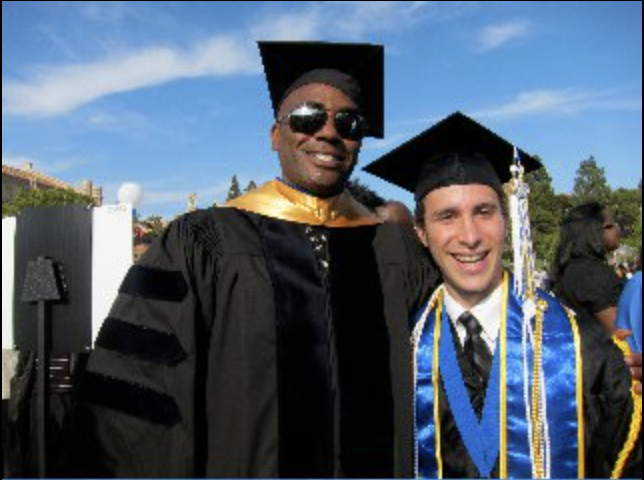
Professor Morrell and I at my UCLA graduation, 2011.
Over the following years, I took another course with him, and visited him frequently in his office. He advised me and wrote me scholarship letters – including for my trip to South Africa – and graduate school letters and just provided sage professional and personal guidance. He inspired me to be selfless at every juncture, and to learn with purpose. He was the father figure to me that I did not have and sorely needed at that moment; an academic powerhouse, but also a role model. He taught me – no, showed me – what it meant to practice love in the classroom, to believe in young people, and dedicate yourself to enriching the dreams of others. He taught me that everything we do has to be steeped in love. No lesson plan or assignment, no relationship, no action, none of it matters unless we do it with the type of revolutionary love he modeled every day.
As I graduated from UCLA, he also was leaving to take the director position at the Institute for Urban and Minority Education (IUME) at Teachers College, Columbia University. As I made the choice to pursue a graduate degree there, I had the unbelievable fortune of working closely with him over the next six years: building IUME (with so many others) from an afterthought housed off-campus to the college’s premier research institute. Year after year, I literally followed him to every lecture, every talk, every event he participated in, recording them as much as for our institute’s digital library as for myself. I would even record our meetings (with his permission), just so I could re-listen – because in real-time, my brain and my heart could not process such wisdom. He continued to believe in me, guide me, lift me up, and just allow me to grow as a scholar and person, mistakes and all (and I made many). And I had the privilege of witnessing his brilliance and humanity every day. His presence was both magnetic and magnanimous; I watched him time and time again, in public, breathe inspiration into legions of people of how to research and teach through innovative, critical, and justice-oriented work. And he challenged me and all of us and never let us off the hook: “don’t just say that this research has future applications for school: develop a curriculum, show them what it looks like!” His belief in the brilliance and power of our youth was almost divine, and he used his position and resources to uplift them, and those who shared that goal. “We must let the youth shine, for they are light and we are nurtured and energized by that light,” he emotionally declared at an event in 2012. “Our youth aren’t an obligation, they are not a cause, and they are not a duty: they are the very reason we are here. They are the reason for our existence – for our lives...” In fact, his entire belief in people was majestic: in one of our first meetings at IUME, Professor Morrell made it clear that IUME was not a “what,” but a “who.” The institute — mirroring his broader work and career — would be about people.
Of course, his groundbreaking scholarship will live on forever, and his accomplishments too vast to name – his genius as a public intellectual is unparalleled. But it is his unbridled genius interwoven with his extraordinary decency and humanity that made him so transcendent and so beloved and unlike anyone who has ever or will ever walk this Earth. Still, despite literally writing the book (literally and figuratively) on progressive pedagogies and youth-centered, critical race-focused and justice-based work, he also eschewed dogmas. He was inspiringly open-minded, not afraid to push back against certain credos or doctrines in academic circles. At the same time that he was an unapologetic and absolutely fearless champion of marginalized students – particularly Black students and communities – deeply steeped in his own cultural history, he also was eager to look beyond the confines of race and identity, too. His diverse set of colleagues and advisees spanned every background and perspective. He had no agenda other than love – and the type of revolutionary love, as he both preached and practiced in public, only exists in a universal form.
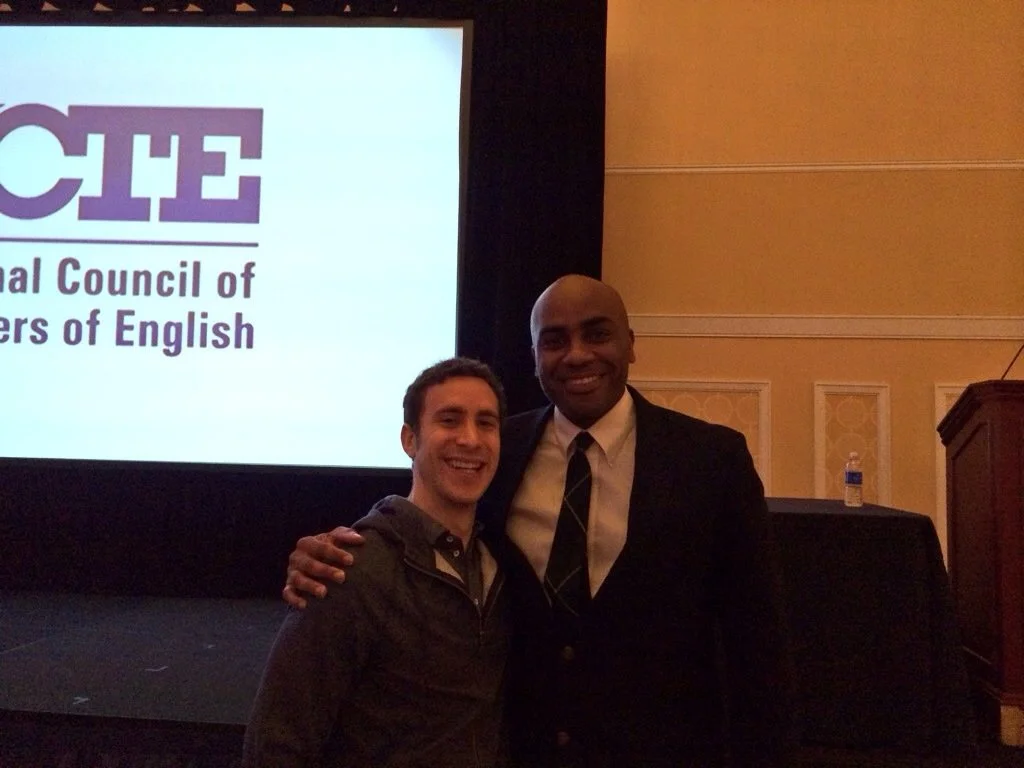
Professor Morrell and I at the 2014 NCTE Conference.
But it was what he did in private that spoke to his uncommon magnanimity. For all his accomplishments and genius, he was uncommonly modest, sincere, kind, and patient. Even, at least as I observed, quiet and gentle in his own way – Professor Morrell, ever the scholar, ever the writer, ever the thinker. A true renaissance man that, to me, was this giant of a person in every sense of the word: a beautiful soul whose benevolence should not belie his ferocity as a scholar. He was a giant of all giants. And I observed him time and time again treat all people, every single person he interacted with, with remarkable dignity. At IUME, in the quasi-“Ernest Morrell/IUME historian” that I became during those years, I bore witness to his beautiful humility, a rarity in academic circles. Behind the scenes – as so many have testified about him – he served as a pillar for support for countless students, giving every part of himself in innumerable ways. He went beyond maximum capacity every day of his life, in private, to champion those he believed in. And, gosh, he believed in so many. He believed in all of us. This is why his legacy will always be larger than life. Like his former student said that rainy night in New York City, we are all here because of him.
As he left Teachers College to pursue a new journey at Notre Dame, for the first time in 11 years, I was either no longer at the same institution as him or working with him professionally (he was on my dissertation committee until I defended in 2019). Now from afar, I saw him pursue new lines of scholarship around Catholic education, in ways I did not expect – again, showing that he is full of surprises and ingenuity, and faith. I realize now that he was always a man of great faith: he had faith not just in God, of course, but in the world. Faith in the power of love, faith in people, faith in all of us. I will forever be gratitude that he had faith in me.
There are students and friends and colleagues who know Professor Morrell far better than I do, particularly in his recent years at Notre Dame (and of course his early life and career pre-UCLA). I was not privy to the details of his long battle with cancer, other than knowing that he battled it with his trademark grace and courage. He kept going, and fighting, and writing and thinking and inspiring and mentoring and loving. I cannot fathom the strength – and faith – it must have taken to carry on. But yet he did.
*****
When I moved back to Los Angeles in 2017 (although I was still working on my Ph.D. at Columbia), I needed a job. With no L.A. network, I wasn’t sure where to look or turn. But, somehow Professor Morrell was, again, there for me. Just like when I first moved to New York and he offered me a much-needed position at IUME, and when he soon after connected me with a then-new professor who would become my primary advisor and mentor, he was there for me again in L.A. As I eventually learned, he made a call to a former student of his – now an administrator at a local community college by me – and told her (as she recounts it now) “take care of Barry.” That call put in motion opportunities that I can trace to my current position.
As a lecturer now, I teach about 1,000 students in 12 courses each year. And every single day I think about him: I borrow his mannerisms —"hello beautiful people!” – and share his scholarship and model my teaching after him, but more than anything, I try (imperfectly) to exist in the world like he did, in joy, in hope, in love. He taught me, during the most formative years of my life, more than any person, how to grow my capacity to love. He taught me that education doesn’t have to be rigid or stingy or impersonal; he taught me that our jobs as educators, particularly as faculty, is to be gate openers, not gate keepers. His personal and professional impact on me is so profound, it is unquantifiable. Again, there are other people – special people – who knew him much better than I did, in much closer and much longer working capacities than me. I was only ever his student, but it is a title that I will always hold with reverence and gratitude for the rest of my life: that I had the great fortune to be taught, mentored, believed in, and loved by Ernest Morrell. They say a person should never have heroes, but he will forever be mine.
I cry and I mourn for your passing and all that you meant to me and to your family and to your students and your friends and your colleagues, and to this world. Like so many posts and sentiments, I will try hard to honor your legacy every single day and to make you proud. I love you more than I can ever express. As you once pronounced: “It is our work with others that make us eternal.” You will always be eternal. I love you forever and may your beautiful soul rest in peace.
